
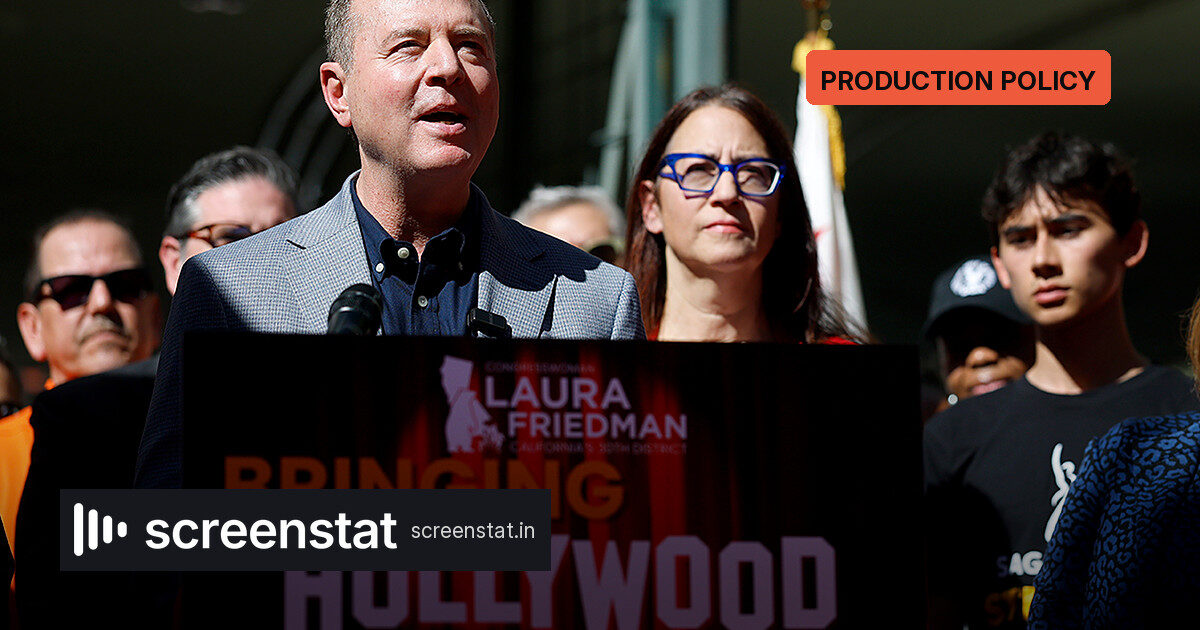
Democratic lawmakers and entertainment union leaders rallied Tuesday in Glendale to push a federal film and television incentive through Congress before the session ends. The bill would create a 20%-30% transferable tax credit on U.S. labor costs for qualifying film and TV productions.
Sen. Adam Schiff said the measure has 12 Senate backers, split evenly between Democrats and Republicans, and argued that Washington can no longer ignore competition from roughly 65 other countries that offer production incentives. “We are so close to getting this done,” Schiff said.
Why the numbers changed the argument
A union coalition published a report Monday tracking the erosion of U.S. production as a share of global spending over 25 years. Film fell from 74% to 42%; television fell from 94% to 64%, even as both industries grew overall. The share loss is the political engine behind this push: it turns a tax question into a jobs question.
The federal credit could stack with state incentives in California and New York, lifting the combined value above 50% for some projects and surpassing many overseas programmes.
What the bill actually contains
- A 20%-30% transferable credit on U.S. labor costs.
- A 5% bonus for filming in a disaster area, covering Los Angeles County until January 2030.
- Additional bonuses for independent films and rural opportunity zones.
- Transferability, which lets producers monetize the credit even without federal tax liability.
The political clock
Supporters have roughly five weeks during the lame-duck session after the election. The latest Senate cosponsors are Thom Tillis, R-N.C., and Chris Coons, D-Del. Rep. Laura Friedman said she is “cautiously, guardedly optimistic” and wants the bill on the president’s desk by mid-December, likely as part of a larger tax package.
The Motion Picture Association has urged speed as well but says it is important to “get this right.” Union leaders are less patient. Mike Miller of IATSE said passage in the lame-duck session “will immediately impact production in 2027.”
The read for content businesses
For media planners and entertainment marketers, this is a capacity signal as much as a subsidy. If the bill passes, U.S. production could accelerate in 2027, especially in disaster-eligible Los Angeles and independent or rural shoots. A fail scenario would preserve the status quo of chasing offshore incentives.
The practical move is scenario planning: model the federal-plus-state stack now, compare it with current offshore offers, and hold final location budgets until the tax package text is clear. The transferability clause matters because it changes the value of the credit for low-tax-liability producers.
Source: Variety