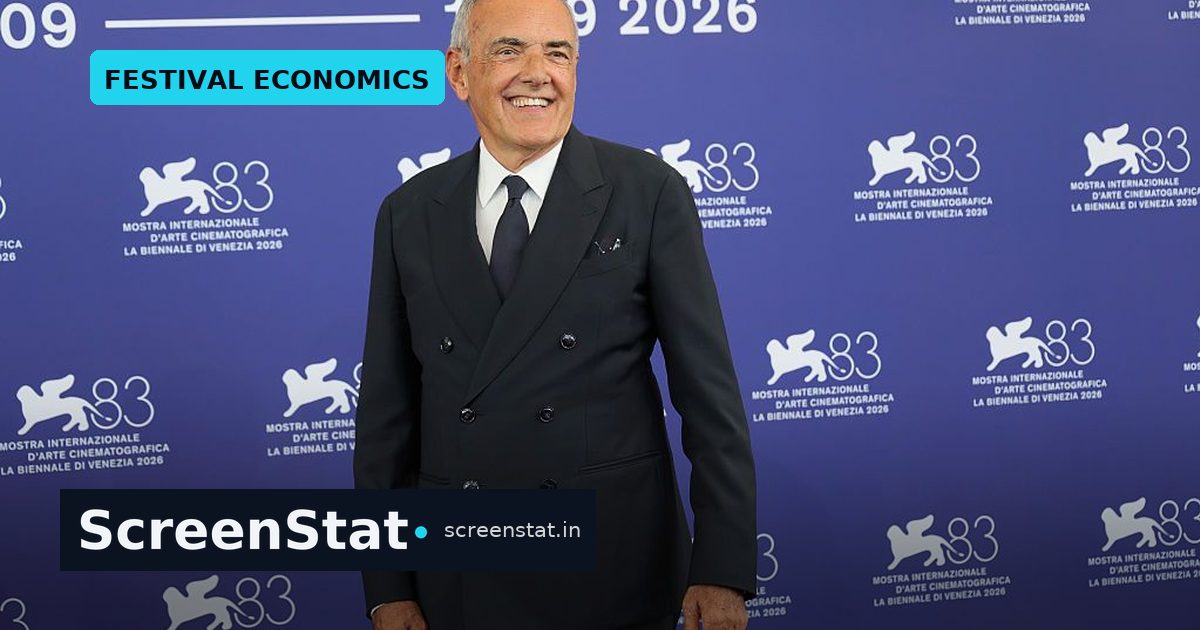
Venice artistic director Alberto Barbera has used his traditional mid-festival interview to make an unusually blunt case on three fronts that matter to the film business: artificial intelligence is already inside the production pipeline, the absence of US studio titles is a readiness problem rather than a snub, and the cost of showing up at a major festival is trivial next to a studio marketing budget.
AI is no longer a panel topic. It is in the selection
Barbera told Deadline that AI-assisted filmmaking will keep expanding in the festival’s line-up, comparing the moment to the digital shift of the late 1990s that the industry initially resisted and then absorbed within a few years. He argued the impact this time will be far bigger.
The concrete markers at this edition: Danny Boyle has said AI was used in making opening film Ink, and the official selection includes a documentary made almost entirely with AI. Barbera also said plainly that filmmakers and studios are already using the tools without disclosing it, because it is cheaper and faster than CGI and can be better.
For anyone planning marketing or acquisitions, that is the operative line. Disclosure is lagging usage. If a festival programmer is saying it out loud on the Lido, the assumption that a prestige title is AI-free is no longer safe, and any campaign built on “handmade” positioning carries reputational risk.
Why the American studios skipped Venice
Barbera’s answer was flat: the films were not ready, and the studios will return. He said the reaction to Ridley Scott’s film was poor and the team knew it, that the David Fincher title will be finished in roughly four weeks but was still shooting in August, and that The Social Reckoning was in reshoots in August. By his account, only Digger was genuinely ready and opted out of the festival circuit.
On the argument that festivals are expensive and risky, he was dismissive. On a film costing $300 million with another $100 million in marketing, he said, an extra $1 million to come to Venice is nothing.
He is right on the arithmetic, and it is the number worth internalising:
- A festival launch is roughly 1% of a tentpole’s marketing spend.
- The real variable is not cost, it is confidence in the reaction.
- A bad Lido reception is a P&A problem that no media buy fully unwinds.
- So festival attendance functions as a signal of internal confidence, not of budget.
Read studio absences that way and the pattern becomes legible: titles that stay home are either unfinished or untested internally.
The box office counter-argument
Asked whether big studio films still need a festival at all, given that Sinners, Backrooms, The Odyssey, Marty Supreme and to a degree A Complete Unknown performed without one, Barbera pushed back that most of those simply were not ready in time, and that the biggest performers were genuine surprises nobody forecast.
His more interesting observation was demographic: cinema audiences are getting younger, and that will change both what gets made and how it is released. For media planners, that is the sentence to carry out of this interview. Festival prestige is a narrow, older-skewing awards funnel. A younger theatrical base is reached through platform-native and social discovery, which is why several of those titles broke out without a Lido premiere.
Oscar reads and the political scheduling row
On Academy prospects, Barbera flagged the Martin McDonagh film as certain to be in the mix, allowed that Robert Pattinson could figure for Primetime while noting the film’s darkness could be an issue, and called Lee Chang-dong’s Possible Love very strong and a likely contender, with the Kore-eda title also praised.
He was candid about why politically charged films land late in the schedule. On the Gaza documentary NAZA, he said he did not want it early because politics would then dominate the festival conversation and overshadow everything else. On the Venice4Palestine petition seeking a Palestinian flag on the red carpet, he said flag protocol is set by the state and the Italian government does not recognise Palestine, adding that he considers that a shame and hopes recognition comes soon.
On women directors, with only two films in Competition, he rejected a dedicated section as a “ghetto”, noted half the selection committee is female and that the Biennale College Cinema slate is 50% women because the festival controls that process, while submissions it does not.
Barbera has two years left on his contract after this edition, and says the decision on what follows is the board’s, not his.
Source: Deadline