
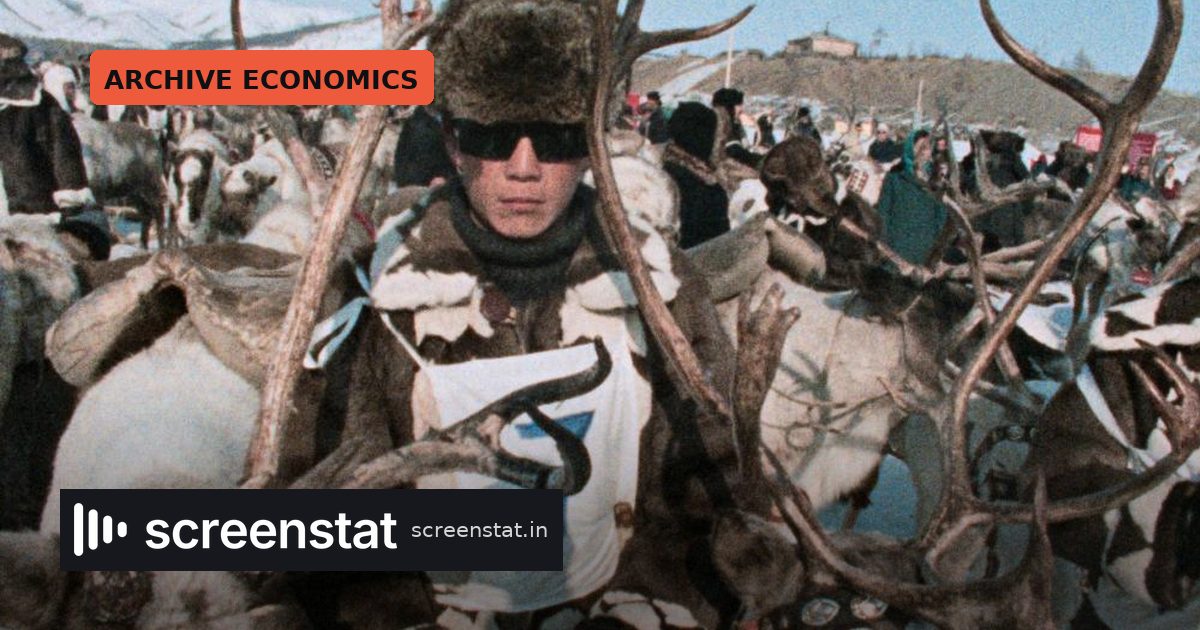
Half a century after Italian film crews fanned out across the Soviet Union, the material they shot has finally found an audience. Sergei Loznitsa’s Imperium, reviewed by Variety, is assembled from roughly 60 hours of 16mm footage captured in the early 1970s for an ambitious multi-chapter Italian television series that was largely never broadcast. Only a handful of episodes made it to air, once, before the whole thing went into an archive and stayed there.
For a publication that tracks the business of screens, that is the story as much as the film is. An expensive commissioned production was shot, cleared with official Soviet permission, and then written off. The value sat dormant for five decades until a filmmaker with a track record in archive cinema found a use for it.
What the film actually is
Loznitsa, whose earlier archive-driven works include Maidan and State Funeral, organises the material geographically rather than chronologically. The journey begins in Moscow, moves east across Siberia, doubles back through Central Asia and the Baltic republics, and closes in what was then Leningrad. Per Variety, the footage has essentially been restored and edited, with some conversation and music layered in, but not reframed with narration or talking heads.
The content is granular in a way period television rarely was: a Red Square parade for the 24th Congress of the Communist Party, GUM department store windows displaying tuxedos and beaded handbags, an old woman washing clothes in an ice hole in Suzdal, Bactrian camel races near the Mongolian border, reindeer sleds in the Sakha Republic, mosques in Bukhara and churches in Etchmiadzin. Variety’s verdict is mixed on the shape rather than the substance: at nearly three hours, the running time is felt, because the film lacks the forward pressure of a single historical event.
Why this matters commercially
Archive is the most under-exploited asset class in the screen business. Broadcasters, production houses and film bodies across markets — India very much included — sit on decades of unaired, part-aired or one-time-aired footage whose rights position is murky and whose commercial value has never been assessed. Imperium is a reminder that dormant material can become a festival-grade feature with a modest incremental spend: restoration, edit, clearances, and an authorial point of view.
The practical questions any rights holder should be asking:
- What do we actually own? Unaired commissions often have the messiest chain of title. Establish that first, not after a filmmaker comes calling.
- Is it catalogued at shot level? Unsearchable footage is functionally worthless. Metadata is the difference between an asset and a storage cost.
- Who is the author? Raw archive rarely sells itself. The premium comes from a named filmmaker’s structuring intelligence, which is exactly what Loznitsa supplies here.
- Where does it land? Festival documentary into specialist streaming and educational licensing is a real, if modest, revenue path — and a durable one, because archive films age slowly.
The long-form problem
The other lesson is about duration. A near three-hour observational documentary is a hard sell on a platform interface built for browsing, and Variety’s central reservation is precisely that the film’s concept is diffuse relative to its length. Ironically, the material was originally conceived as episodic television — the format that would probably serve it best today. Any platform acquiring work like this should be asking whether the archive has a series cut in it, not only a theatrical one.
Variety also points to context that programmers can use: a 1977 National Geographic volume was among the first popular Western correctives to the monolithic image of Soviet life, and Federico Ferrone and Michele Manzolini’s 2013 found-footage documentary The Train to Moscow: A Journey to Utopia makes a natural companion title. Curated pairings, not single drops, are how documentary catalogues earn their keep.
Source: Variety