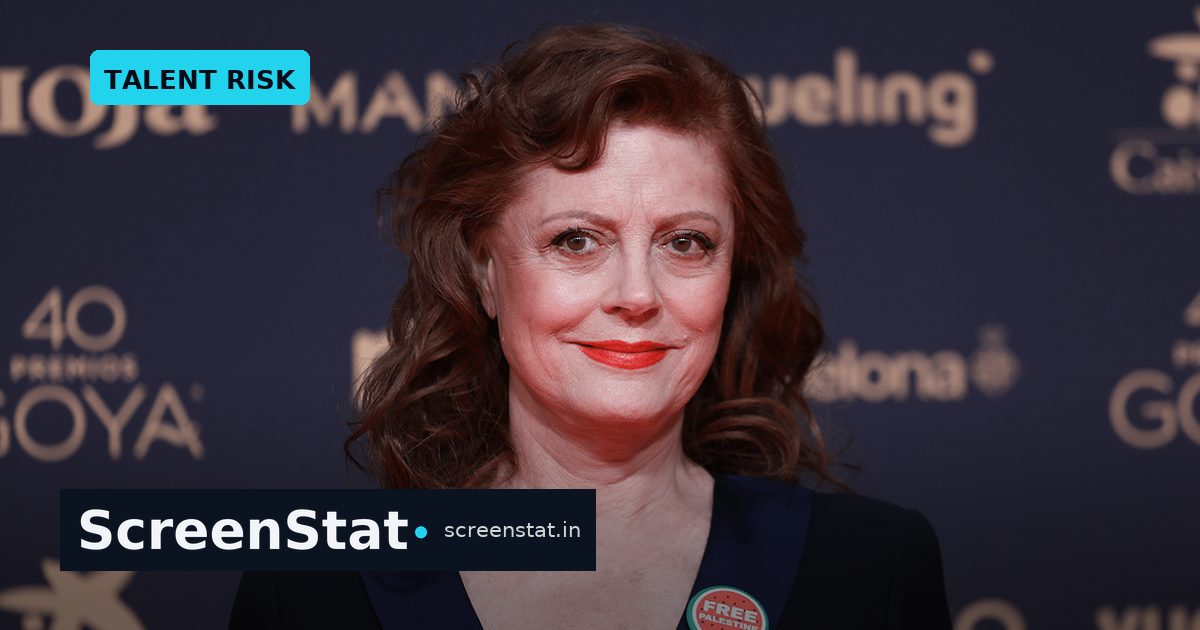
Susan Sarandon used a Venice Film Festival press conference to say something the film business rarely puts on the record: that political speech can quietly cost an actor work. Speaking about her new film The Echo Chamber, Sarandon said she has had “movies taken away” recently because, in her words, there are agencies telling people not to hire her.
Asked whether the mood in Hollywood around the war in Gaza had shifted, she said the narrative had “completely changed” among the public and internationally, but that the industry’s power structure had not moved with it. She singled out major studios as the place where projects become, as she put it, impossible — and thanked director Andrea Pallaoro for ignoring warnings and casting her anyway. The room applauded.
The background, in short
Sarandon drew heavy criticism in November 2023 for remarks at a pro-Palestinian rally in New York’s Union Square, where she said Jewish Americans were “getting a taste of what it feels like to be a Muslim in this country.” United Talent Agency, which had represented her since 2014, dropped her days later. She issued a public apology the following month, calling the phrasing “a terrible mistake” and saying she regretted diminishing the long history of antisemitic persecution.
The Echo Chamber, an Italian production directed by Pallaoro, premiered at Venice on Sunday. Sarandon plays a retired rock singer pulled back into performing, opposite Alicia Vikander and Luca Marinelli, and performs original songs written by Clément Ducol and Émilie Gassin. The Hollywood Reporter’s critic Sheri Linden called it “a terrific role,” noting that Sarandon’s screen career began 51 years ago with The Rocky Horror Picture Show.
Why this matters commercially, not just culturally
Strip out the politics and what is left is a casting-risk story — and casting risk is a financing input. Studios and streamers underwrite a title on assumptions about marketing reach, brand safety for advertisers, retailer and platform placement, and international clearance. Any variable that makes those assumptions wobbly gets priced in, usually by removing it rather than paying for it.
That is the mechanism Sarandon is describing without naming it: not a formal ban, but a series of individually defensible risk decisions that add up to fewer offers. And it works in one direction. The people who say no are never required to explain the no.
The two-market split
The more useful signal here for anyone who buys, sells or plans screen content is the gap Sarandon draws between systems:
- Studio and platform commissioning — large marketing spends, advertiser exposure, multi-territory rollout. Highest sensitivity to talent controversy.
- Independent and European auteur production — smaller budgets, festival-led discovery, critic-driven awareness. Far more tolerant, because the downside is capped.
- Festival circuits — still the cheapest way for a project with perceived talent risk to acquire prestige and distribution interest.
- Representation — agencies are now visibly part of the risk chain, not neutral intermediaries. Losing an agency is a distribution problem, not just a career one.
What to take from it
For marketers and commissioning teams, the practical lesson is to decide talent-risk policy in advance rather than in the middle of a news cycle. Reactive decisions are the expensive ones: they burn relationships, invite accusations of blacklisting, and rarely change the underlying audience math. For independent producers, the flip side is opportunity — Pallaoro got a 51-year screen veteran, a strong lead role and a Venice premiere partly because the studio system had made her available.
That is the actual number worth watching in stories like this: not the outrage, but who ends up cheaply acquiring talent that the largest buyers have decided they cannot price.
Source: The Hollywood Reporter