
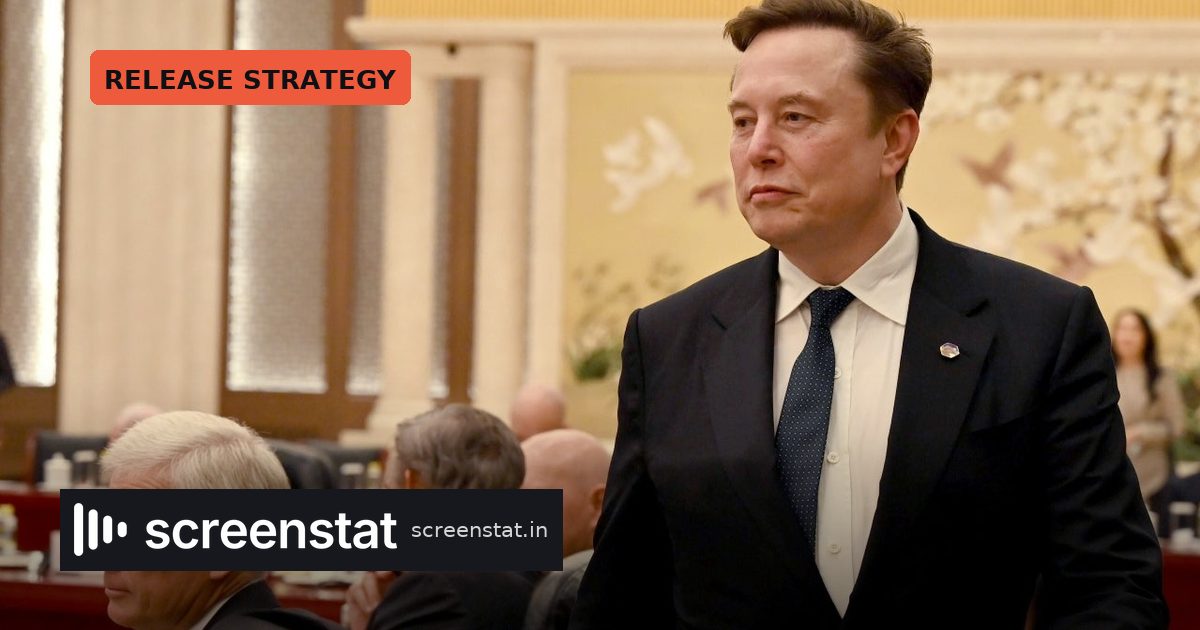
Alex Gibney’s long-gestating documentary on Elon Musk has a trailer, a premiere date and, more interesting for anyone tracking release economics, a two-stage rollout that stretches across two calendar years and two very different distribution models.
Musk world premieres at the Venice International Film Festival, ahead of a US theatrical release from Bleecker Street on Oct. 16. The theatrical cut runs 235 minutes. An even longer version is set to land on HBO sometime in 2027, according to TheWrap.
What the trailer signals
The teaser is built around a SpaceX launch. As the rocket climbs, the soundtrack stacks up the flattering framing that followed Musk for a decade \u2014 the \”real-life Iron Man\” line, the great-capitalist framing, the futurist framing. As the vehicle starts to wobble, the commentary turns to narcissism and unchecked power. It is a tidy piece of structural editing, and it telegraphs the film’s thesis without a word of narration.
The official logline describes the film as an incisive look behind the legend of the world’s most heralded \”investor-entrepreneur.\” Per the report, Gibney started out making a comparatively conventional portrait of a Silicon Valley figure, and the film changed shape as Musk’s political and financial footprint expanded, including his role inside the Trump administration.
Why the runtime is the story
Two hundred and thirty-five minutes is a serious ask in a theatre. Nearly four hours means roughly one fewer show per screen per day, which mechanically caps per-screen gross no matter how strong the demand. Distributors who go this route are not chasing wide-release box office; they are buying cultural positioning, awards eligibility and press coverage that a straight-to-platform drop rarely generates.
Bleecker Street is a specialty distributor, and the play here reads clearly:
- Venice premiere to set the critical narrative and generate international pickup interest.
- Limited theatrical in October to establish the film as an event and qualify for the awards calendar.
- A longer HBO version in 2027 to capture the audience that will never sit through four hours in a cinema but will happily watch across two or three nights at home.
That last step is the part media planners should note. Rather than trimming for the platform, the producers are expanding for it. Streaming and premium cable have effectively become the director’s-cut window \u2014 the place where length is a feature, not a liability, because the pause button removes the constraint that theatrical exhibition imposes.
The Gibney track record
Gibney is one of the most bankable names in the documentary business, with Enron: The Smartest Guys in the Room, Going Clear: Scientology and the Prison of Belief and The Inventor: Out for Blood in Silicon Valley behind him. His films reliably convert into conversation, which is the currency documentaries actually trade in \u2014 subscriber acquisition and retention value tends to come from the news cycle a title generates rather than raw hours viewed.
What it means for the market
For Indian buyers and platform programmers, the takeaway is about scheduling and format flexibility. A subject-driven documentary about a globally recognisable figure travels well, but the 2027 HBO date means the streaming version arrives more than a year after the theatrical conversation peaks. That gap creates a real risk of narrative decay on a fast-moving subject \u2014 and an opportunity for whichever platform holds rights in each territory to re-ignite interest with a fresh marketing beat.
The other lesson is more practical: when a title runs long, plan the campaign around episodes of attention rather than a single opening weekend. Trailer, festival reviews, theatrical release, and then a platform drop are four separate spikes. Treating them as one campaign wastes three of them.
Source: TheWrap