
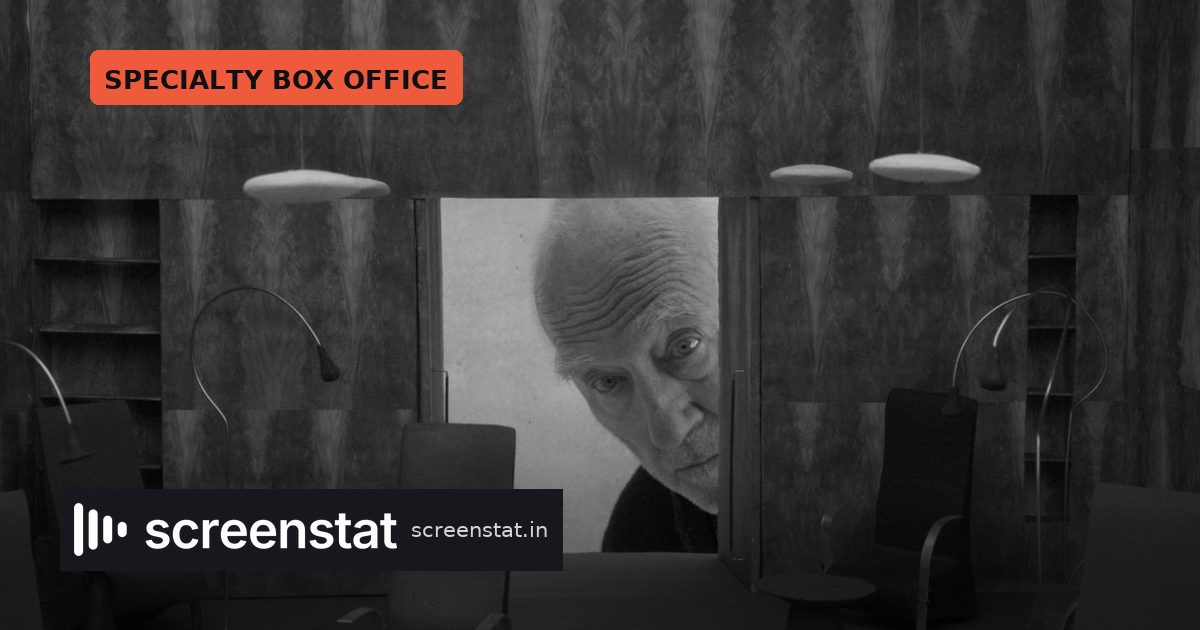
Wim Wenders has premiered From Inside Out — The Architecture of Peter Zumthor at the Venice Film Festival, a 3D documentary about the Swiss-German architect, backed by Brad Pitt. TheWrap’s review calls it a success on its own terms — and flags, bluntly, that those terms are about as niche as niche gets.
For anyone who books screens, buys media or acquires arthouse titles, that combination is the interesting part. This is a premium-format film about a subject with almost no built-in movement or music, arriving with a marquee producer name attached and a genuine theatrical hook. It is a live test of whether the specialty 3D documentary is a viable line item or a passion project that happens to find distribution.
Wenders has been running this experiment for a decade
The director’s 3D track record is not incidental. He used stereoscopic 3D on Pina, then on the melodrama Every Thing Will Be Fine with James Franco and Rachel McAdams, which the review describes as largely forgotten. In 2023, Anselm — a fine-art documentary with a far less recognisable cast — grossed nearly three times as much as that star-led drama.
That single data point is worth sitting with. A documentary about a painter, with no stars, outperformed a 3D narrative feature with two known leads by roughly 3x. TheWrap wryly credits the premium-format upcharge. The more useful reading for distributors: in specialty theatrical, format and subject fit matter more than casting. When 3D actually serves the material — depth of space, scale, texture — audiences pay the surcharge. When it is bolted onto a drama, they don’t.
What the Zumthor film is actually selling
According to the review, Wenders uses 3D here in his most relaxed way yet: not for spectacle, but simply to deepen the image and let Zumthor’s minimalist, often horizontal buildings across Germany and Norway carry the film. It plays, in the reviewer’s framing, like a luxury travelogue. Guests including writer Siri Hustvedt and musicians Sophie Hunger and Aoi Yamada appear at each site to create a dialogue between performer and place — an attempt to smuggle movement and melody back in.
The final act goes to Zumthor’s David Geffen Galleries in Los Angeles, which houses LACMA’s permanent collection and stretches from Wilshire Boulevard to the La Brea Tar Pits, with cameo appearances from Werner and Lena Herzog and Ava DuVernay.
The marketing hook is a building, not a movie
That LA opening is the closest thing this film has to a demand spike. American awareness of Zumthor is arguably at an all-time high because of a building people can walk into. But TheWrap identifies the tension: visitors to the Geffen Galleries are likely more interested in the art inside than the architecture around it, and the film needs the opposite.
For a release plan, that suggests a tightly geo-targeted approach rather than a broad specialty rollout:
- Anchor on premium screens. The 3D is the product differentiator; standard-format bookings dilute the pitch and the ticket price.
- Cluster around the institution. Los Angeles, plus museum and design-school markets, where the audience is already self-selecting.
- Sell the venue, not the biography. The review notes Zumthor’s own life story is not the draw. The buildings are.
- Plan for a long tail. Fine-art docs earn out over months and through downstream windows, not opening weekend.
- Treat the Pitt credit as press, not demand. A producer name opens coverage; it does not sell tickets for architecture.
Why it matters
Specialty theatrical has become a barbell: event-scale titles at one end, hyper-targeted cultural programming at the other. Films like this one live entirely at the second end, and their success is measured in per-screen averages and premium-format mix, not headline gross. Wenders keeps proving that the surcharge holds when the format earns it. That is a repeatable lesson for anyone underwriting a documentary slate — and a caution against assuming a famous name on the poster changes the addressable audience.
Source: TheWrap