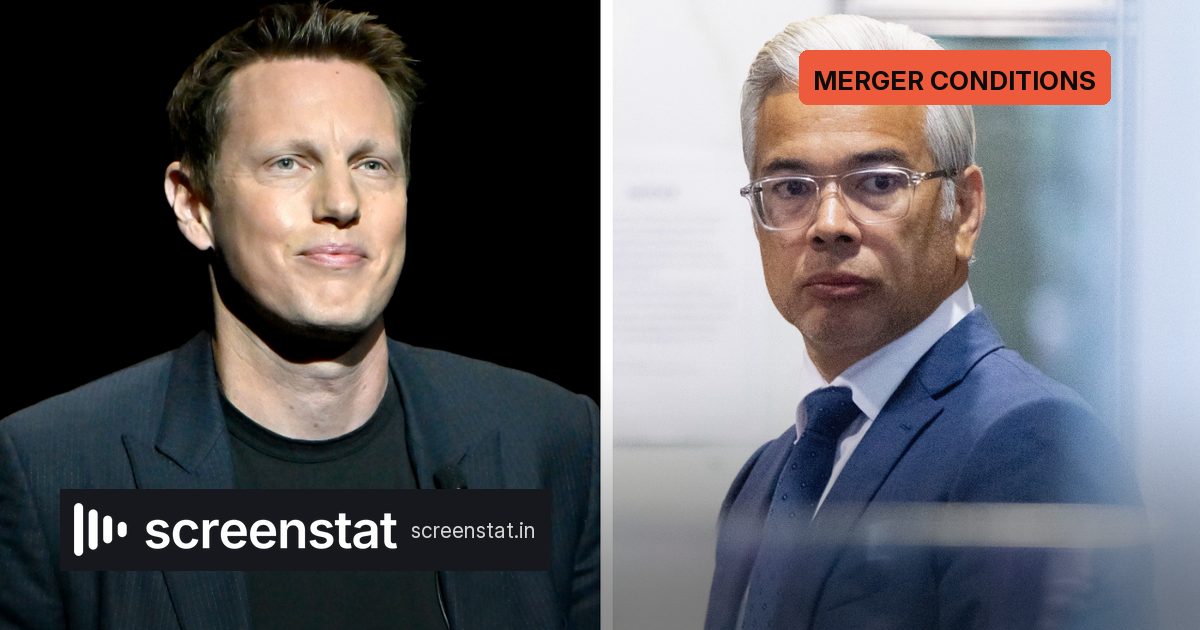
Paramount CEO David Ellison and California Attorney General Rob Bonta now have a court date to turn their tentative settlement into a working consent decree. U.S. District Judge Araceli Martinez-Olguin has scheduled a Thursday hearing on the proposed agreement that would resolve a 12-state attorneys general antitrust challenge to Paramount’s $110 billion acquisition of Warner Bros. Discovery.
The judge has not approved the settlement. She also scrapped a previously scheduled hearing on Paramount’s $1.88 billion bond request, signaling that the consent decree—not the bond—is now the main event.
What Paramount has committed to do
If the decree holds, the combined company would face enforceable production and spending floors. Paramount agreed to invest at least $300 million annually in U.S. TV and film production, or $1.5 billion over five years. It also committed to release 30 films per year for the first two years, rising to 32 per year for the following three.
- At least four films per year must be independent productions.
- At least 20% of the slate must be blockbusters.
- If Congress passes a federal film tax credit, 20% of film production must stay in the U.S. for two years, rising to 30% for three more.
Those volume and spend floors are the kind of enforceable numbers state regulators often use to preserve local industry jobs and production capacity after a merger. For media planners and buyers, they signal that Paramount is likely to remain a consistent supplier of new film and TV inventory during the commitment period.
Editorial and distribution guardrails
The settlement creates an editorial board to monitor CNN and CBS News independence, with five established journalists who have practiced for at least ten years. No more than two board members may be affiliated with the same political party, and members would serve three-year terms.
On distribution, Paramount and Warner Bros. Discovery would continue negotiating cable packages separately for five years. The decree limits changes to affiliate fee negotiations and restricts the use of confidential information. The free, ad-supported Pluto TV would also continue operating during the commitment period.
Why the terms matter for buyers
The agreement shows how state AGs are extracting conditions that go well beyond a simple merger review. Instead of blocking the deal, they are using the consent decree to set production minimums, protect newsroom independence, preserve separate carriage negotiations and maintain a free ad-supported service. For streaming and TV buyers, that means Pluto TV remains a stable FAST inventory source, and CNN/CBS editorial structure faces a multi-year oversight mechanism.
The deal also includes $9.5 million a year for five years in workforce training and career development, plus a $5 million annual independent film purchasing fund to be established within 30 days of closing. Studio lots and collective bargaining agreements must be maintained.
Thursday’s hearing is scheduled for 11 a.m. PT on Zoom. The judge said it will address:
certain outstanding questions regarding the factual and legal underpinnings of the parties’ proposed consent decree, as well as the implementation of the proposed consent decree.
What to watch
For ScreenStat readers, the number to watch is not the $110 billion price tag but the $1.5 billion five-year production floor—because that is the line regulators may enforce if the combined company under-delivers. Do not assume the merger will close free of conditions; track whether the production minimums survive Thursday’s hearing intact. Any weakening could change the volume of content available to license or schedule.
Source: TheWrap