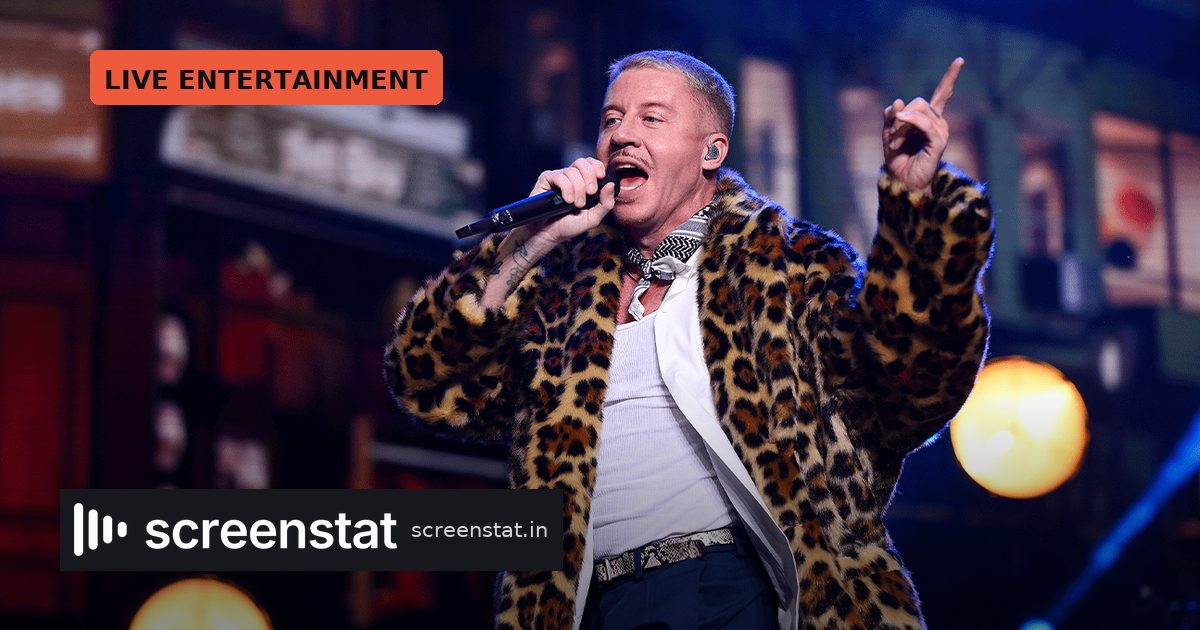
Macklemore is not backing away. After his opening set on Ed Sheeran’s Loop Tour became a flashpoint, the rapper posted on Monday that wanting all humans to be treated equally “should never be controversial,” alongside video of his remarks from the second of two nights at MetLife Stadium in New Jersey.
The sequence, as reported by The Hollywood Reporter: on Friday, Macklemore performed his protest track “Hind’s Hall” and told the crowd that a big reason he joined the tour was to say two words — “Free Palestine” — from stadium stages. He repeated the phrase on Saturday, then addressed Jewish audience members directly, saying criticism of Israel, of apartheid and of genocide was not a criticism of them, and that his message was one of peace and dignity for all people. He extended the list to Lebanon, Cuba, Congo and Sudan, and to people in the United States living in fear of ICE.
The organised pushback
The Israeli-American Council responded with a petition demanding Macklemore be dropped from the remaining tour dates. Its argument was framed around venue, not viewpoint: that this was a Sheeran concert rather than a rally, and that the question is where the line falls when an opening act uses a global concert platform for a one-sided political agenda. The Hollywood Reporter said it approached Sheeran’s representatives and had not received a comment by publication.
That silence is itself the story for anyone who works in live entertainment or brand partnerships. A headliner’s team now faces a decision it did not choose and cannot fully control.
Why a stadium support slot is a media platform
Media planners tend to think of concerts as ticketed events. They are not. A stadium show is a distribution node: 50,000-plus people in the room, thousands of vertical-video clips uploaded within minutes, and an algorithmic second life on short-form platforms that dwarfs the live audience. A 90-second speech from an opening act can out-reach the headliner’s entire promotional campaign for that week.
That changes the risk maths for everyone attached to a tour. The exposure is no longer contained by the venue’s walls or the tour’s markets. It travels wherever the clip travels, unmoderated and stripped of context, and it lands on brands, sponsors, broadcasters and streaming partners who signed up for a music property, not a political one.
What live, brand and platform teams should take from this
- Support acts are unvetted media. Openers are usually booked for audience fit and cost, not message alignment. If your brand’s name is on the tour, the opener’s stage time is your inventory too.
- Petitions are a distribution tactic. Advocacy groups use removal demands to force a public response from the headliner and sponsors. The petition itself is the pressure; the signature count is secondary.
- Silence is a position. A no-comment reads as tacit tolerance to one side and as cowardice to the other. Decide in advance which risk you can live with.
- Clip velocity beats crisis timelines. By the time a statement is drafted, the edit that will define the story has already been seen millions of times. Pre-agreed response tiers matter more than perfect wording.
- Audience overlap is not audience agreement. A Sheeran stadium crowd is broad, mainstream and politically mixed. Broad reach means broad disagreement.
The bigger pattern
Artist activism at scale is not new, but the amplification layer is. Every stage is now a publishing platform, and every performer has a direct channel to defend or extend what they said. Macklemore’s Monday post is a case in point: he did not wait for a news cycle to interpret him, he reposted his own footage with his own framing.
For anyone buying, selling or programming live entertainment, the practical conclusion is unglamorous. Contracts, sponsor agreements and crisis playbooks written for a pre-clip era assume the room is the audience. It is not, and has not been for some time.
Source: The Hollywood Reporter