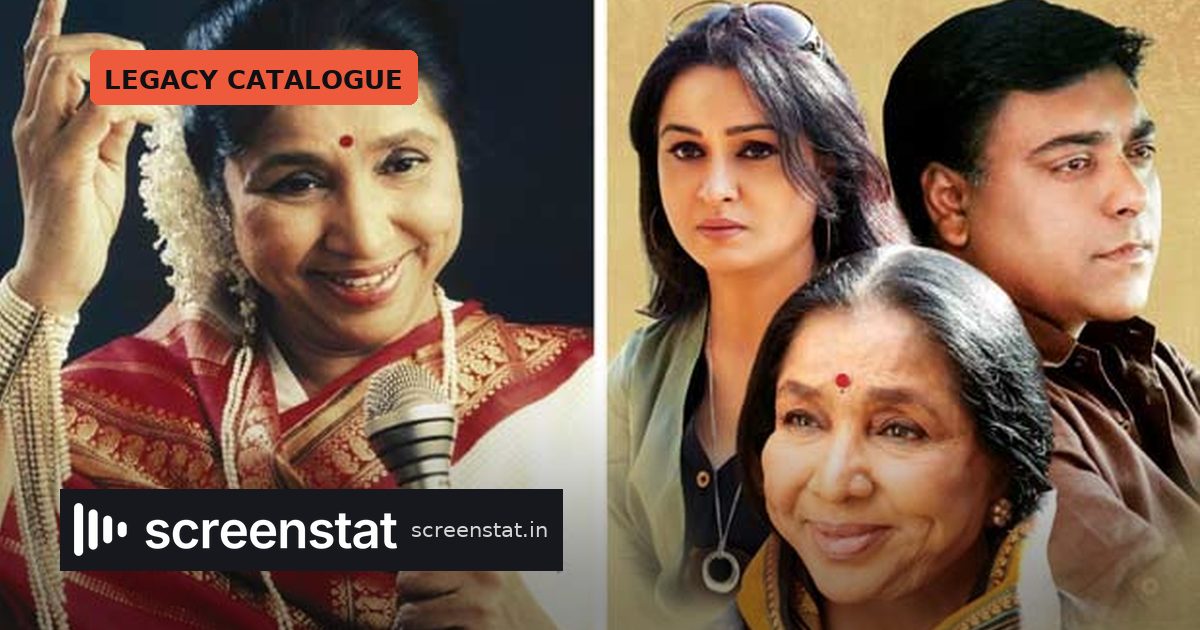
On what would have been Asha Bhosle’s 93rd birth anniversary, a single credit in her filmography is getting fresh attention: Mai, the Hindi film in which the playback legend played the title role – her first and only acting turn on screen. Bhosle died earlier this year, on April 12, at the age of 92.
In an interview with Bollywood Hungama recorded at the end of May, veteran actor Padmini Kolhapure – Bhosle’s niece, who played her daughter in the film – said her aunt “has done such a brilliant job” in the role. Kolhapure also revealed that Bhosle agreed to the film on one condition: that Kolhapure be part of it.
A full-circle credit
Kolhapure framed Mai as a closing of the loop. Her first film as a child, Ishq Ishq Ishq, came to her through Bhosle. Decades later, the two shared a set – and, by Kolhapure’s account, a lot of conversation about family history, including stories about her father and about Lata Mangeshkar.
“When we say she is not with us, it just doesn’t seem real,” Kolhapure said of Bhosle, adding that the work of both her aunts will endure “for eternity” because their songs are still played daily. She cited filmmaker Ashutosh Gowariker telling her that his mornings begin with Asha Bhosle’s songs and his nights end with Lata Mangeshkar’s.
Mahesh Kodiyal, who directed Mai, told the same publication after Bhosle’s death that she was often unsure of her own emotional scenes and would ask Kolhapure to put her at ease – then deliver a strong take and still insist she hadn’t done it right.
Why this matters for programmers and planners
Beyond the tribute, there is a business observation here that streaming and music teams keep relearning: the long tail of an icon’s catalogue is not just the hits. It is the odd, one-off, hard-to-find title – the single acting credit, the regional-language recording, the concert footage – that anchors an anniversary package and gives a curated row a reason to exist.
Bhosle’s screen appearance in Mai is exactly that kind of asset. It is a single film, but it is unrepeatable, and it sits at the intersection of two enormous audience interests: Hindi film music nostalgia and star-family lineage.
The anniversary programming checklist
- Map the rare credits. One-off titles outperform generic “best of” rows because they answer a question fans did not know they had.
- Time the push to the date. Birth and death anniversaries create predictable search and social spikes; the collection should be live before the date, not after.
- Pair video with audio. A film row alone underuses the moment – music platforms and video platforms both benefit from co-promotion around the same legacy.
- Use family and collaborator voices. First-person recollections, like Kolhapure’s, travel further than a studio-cut tribute reel.
- Watch the catalogue tail, not just week one. Legacy content earns its keep in retention and low-cost hours viewed, not in launch-week spikes.
For Indian streamers in particular, the playback-singer canon remains one of the cheapest, most durable engagement drivers available – and, as this anniversary shows, the stories around the catalogue are as programmable as the catalogue itself.
Source: bollywoodHungama.com