What happened in the Sala Grande
Danish director May el-Toukhy did something festival directors almost never do: she stopped her own world premiere. During Sunday evening’s competition screening of Woman Unknown at the Venice Film Festival, the subtitles drifted out of sync with the film. El-Toukhy left the auditorium, and after roughly five minutes of raised voices in the corridor outside — and audible shushing from the seats — the lights came up.
She returned with producer Mikael Riek, who told the audience the film would be rewound by 15 minutes so it could be watched and understood properly. A handful of people walked out. Most stayed. According to the film’s press agent, el-Toukhy and Riek had asked for the subtitles to be realigned and the screening resumed from the point where they had slipped.
The payoff: a seven-and-a-half-minute ovation at the end, with the director and cast visibly moved.
Why a subtitle glitch is a business story
Festival premieres are, functionally, sales screenings. For a Golden Lion contender competing against 19 other titles, the world premiere is the single highest-leverage 120 minutes in the film’s commercial life. Buyers, distributors, streaming acquisitions executives and critics form their read in that room, and the reviews that follow set the terms for territory-by-territory deals.
A misaligned subtitle track on a Danish-language film in an international competition is not a cosmetic problem. It breaks comprehension for essentially the entire non-Danish-speaking audience — which is to say, the buyers. Letting the screening run would have preserved the schedule and destroyed the asset. Stopping it cost about 20 minutes and salvaged the premiere.
The ovation length is worth reading with a cold eye. Venice standing ovations are a soft, self-reported metric that the trade press has turned into a proxy for buzz. Seven and a half minutes is a strong number, but it is not a box office forecast. What it does signal is that the room stayed engaged after a mid-film interruption — arguably a harder test than an uninterrupted screening.
The operational takeaway
For anyone shipping localised content — festival prints, OTT masters, theatrical DCPs across markets — this is a live risk, not a freak event. Subtitle sync failures scale badly: one bad file can hit every viewer in a territory at once.
- Treat the localisation file as a deliverable, not an afterthought. Sync errors usually surface only on playback in the actual venue or player.
- Insist on a technical check in the exhibition environment. A file that runs clean in a grading suite can drift on a different server.
- Have an escalation protocol. El-Toukhy and her producer had one, even if it was improvised: stop, fix, restart, explain to the room.
- Own the moment publicly. Riek addressed the audience directly. That is why the story reads as decisive rather than shambolic.
The gender numbers behind the premiere
El-Toukhy was the only woman named to Venice’s main competition when the lineup was announced in July, alongside 19 men. She has since been joined by Rachel Szor, co-director with Yuval Abraham of the late addition Neza — bringing the count to two.
Speaking to Deadline before the premiere, el-Toukhy said she was “delighted” and “honored” to be in competition but described the imbalance as “very, very much a structural problem,” adding that she has been the only woman in many rooms.
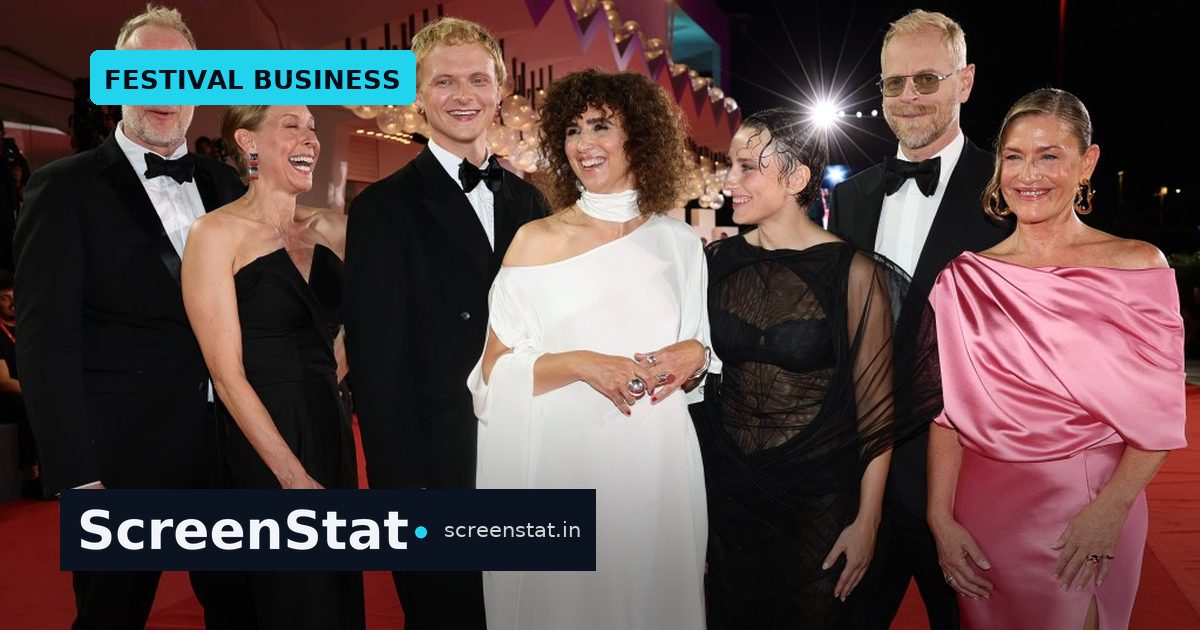
Woman Unknown is set in Denmark in the summer of 1945 and draws on the treatment of women suspected of relationships with German soldiers during the wartime occupation. Mathilde Arcel plays Marie, a nanny and housemaid whose planned marriage to her wealthy older widowed employer, played by Carsten Bjørnlund, is threatened by a secret from her past. El-Toukhy walked the red carpet in a white dress with red embroidery on the back, meant to evoke blood.
Source: Deadline