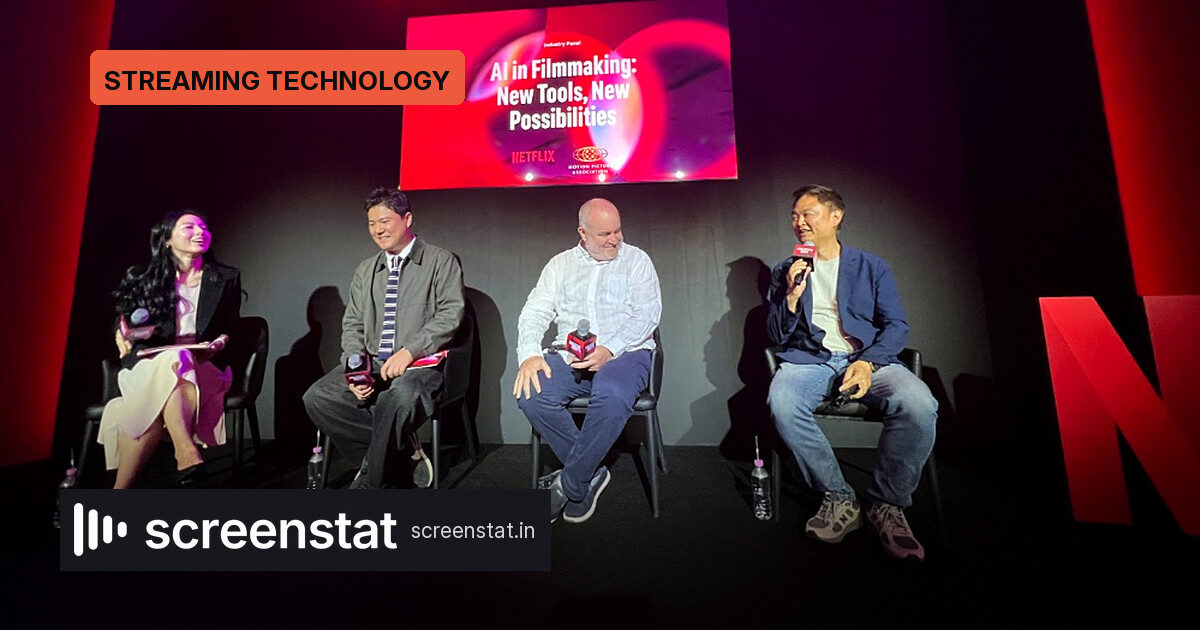
Netflix has now used AI in some form on roughly 300 titles, the streamer’s senior director of APAC production, Lee Sung-gyun, told the Busan International Film Festival. On the same panel, director Kang Yoon-sung put a price on the trend: AI workflows can take 30% to 40% out of a feature film’s production budget.
Where the tools are being used
Lee listed previs, production design, set dressing, editorial and VFX as the areas where AI has been applied across Netflix’s slate. The company also screened an Eyeline reel showing what it calls hybrid production — a pipeline that mixes live-action photography, VFX and generative tools. A clip from the Netflix India title “Glory” showed AI and VFX producing large crowd scenes that might otherwise have been dropped under tight budgets and schedules.
Kang, co-director of “Run to the West” — billed as Korea’s first feature to use AI across its entire production — said the technology has moved quickly. His test for “The Gulf of Aden,” a military-at-sea feature, was made entirely with AI using Kling. Current tools can output 4K at 10-bit color or higher, which he said is enough for cinemas.
- Netflix: AI has touched around 300 titles across previs, design, editorial and VFX.
- Budget: “The Gulf of Aden” fundraising math showed a reduction of about 40%.
- Quality: Tools now deliver 4K at 10-bit color or higher.
The business case
For producers and entertainment financiers, a 30–40% saving is not a technical detail; it changes what can be greenlit. Kang said AI has put projects that previously collapsed at the budget stage back on the table, opening a path for genre and sci-fi films at a time when the Korean industry is struggling to grow. For media planners and marketers, the implication is that AI-assisted productions may change the volume and type of titles entering the market, not just the cost of making them.
The human gate
The panel’s caveat was consistent. Lee said new tools change the “how” of production, not the “why” of storytelling, and added that “a human touch is absolutely essential.” Kang agreed that AI-made footage is technically strong but can weaken emotional delivery because it compresses the collaborative discussion that filmmaking usually requires.
Wētā FX chief technology officer Kimball Thurston framed machine learning as “assistive AI” that is not allowed to change creative intent. He added a practical warning on color: AI trained on video images may give you Netflix red, not Coca-Cola red.
What to watch next
Kang expects the market to split. Short-form content will chase productivity — including, he said, some Chinese projects made entirely with AI from planning to distribution. Film and drama will chase credibility. Wētā is building an open-source provenance tool through the Academy Software Foundation to track AI use, and provenance plus color accuracy are likely to become routine production standards.
For teams adopting these tools, the near-term playbook is to use AI for previs, VFX and crowd work, keep a human pass on the emotional cut, and track provenance rather than treating AI as a complete replacement for actors or creative decisions.
Source: Variety