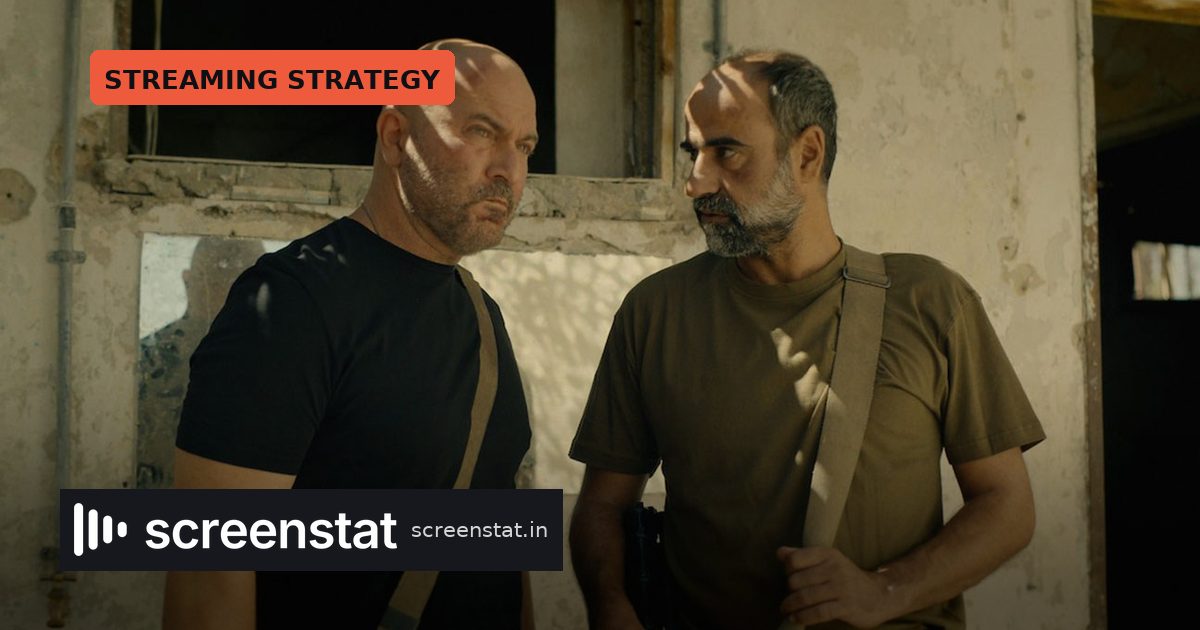
Netflix’s most globally recognised Israeli drama is back, and it is walking directly into the hardest story its creators have ever attempted. Fauda‘s fifth season arrives on the platform globally on Sept. 8, and two of its 11 episodes are set on Oct. 7, 2023, following the show’s existing characters through that day.
The remaining episodes jump forward two years. Per Netflix’s synopsis, the unit races to stop a large-scale attack on Israel while dealing with what the logline calls the cost of “the war after the war.”
What the creators said
Speaking to The New York Times ahead of the premiere, co-creator and star Lior Raz — who plays Doron — described the season as “maybe the most important thing that we ever wrote.” His writing partner, Avi Issacharoff, told the paper the material was something the pair “felt we had to spill it out,” citing pain, loss and confusion, including for people living near the Gaza periphery.
Issacharoff also told Netflix’s Tudum that the writing room was “shaking” while building the two Oct. 7 episodes, and that the team weighed whether the story would deepen the grief of people who had lost family. He added a line that matters for how the show will be read: “This is a TV show. It’s not reality.”
Notably, the season largely avoids Gaza as a setting. Per the NYT report, the story instead moves between Europe, Israel and other points in the Middle East. Issacharoff framed the choice bluntly, saying you try to stay close to reality but “cannot show everything, because it’s too terrible.”
Why this matters for the business
Fauda has been one of the clearest proof points in Netflix’s local-language playbook: a Hebrew-language procedural, made for a small domestic market, that found an audience across continents. That model — commission local, subtitle and dub, distribute globally — is the same one that has produced hits out of Korea, Spain, France and India.
Season five stress-tests the limits of that model in a way most catalogue titles never face:
- Politics travels with the show. A series about a contested conflict does not arrive neutrally in every market. Reception is shaped as much by local sentiment as by craft.
- Boycott risk is now a distribution variable. The season lands amid ongoing calls for boycotts and heightened public argument over the Israel-Gaza conflict, which affects marketing posture, talent availability and social amplification.
- Prestige positioning vs. procedural pull. Two docudrama-style episodes inside an action thriller is an unusual structure. It changes the completion curve — viewers who came for the chase may not finish two hours of trauma.
- Cast breadth is a distribution asset. Alongside Raz, the season features Mélanie Laurent, Hakim Djaziri, Yaakov Zada Daniel and Doron Ben-David — useful for European press cycles.
What to watch after launch
For anyone tracking streaming performance, the useful signals are not the day-one social noise. Watch whether the title enters Netflix’s weekly non-English TV rankings and, more importantly, how long it stays there. Franchise seasons typically open on brand recall and then decay fast; the tell for a genuine hit is week two and three retention.
The second signal is geographic spread. If Fauda charts in a similar spread of countries as previous seasons, the local-language model has held despite the subject matter. If the map narrows sharply to a few territories, that is evidence that politically charged content now carries a measurable distribution penalty — a data point every commissioning team will file away.
The takeaway for planners
Content that carries real-world political weight is no longer just an editorial judgement; it is a media planning question. Brands buying against ad-supported tiers cannot control adjacency at the title level in most markets, and titles like this one make the case for clearer genre and sensitivity controls in streaming inventory.
For programmers, the lesson is simpler: local-language originals earn global scale precisely because they are specific. That specificity is the asset — and occasionally the risk.
The season was directed by Omri Givon, with a writing team including Omri Shenhar, Issacharoff, Raz, Sari Azoulay Turgeman, Givon, Yona Rozenkier and Nir Berger. It was created and executive produced by Issacharoff and Raz, and produced by Liat Benasuly.
Source: The Hollywood Reporter