
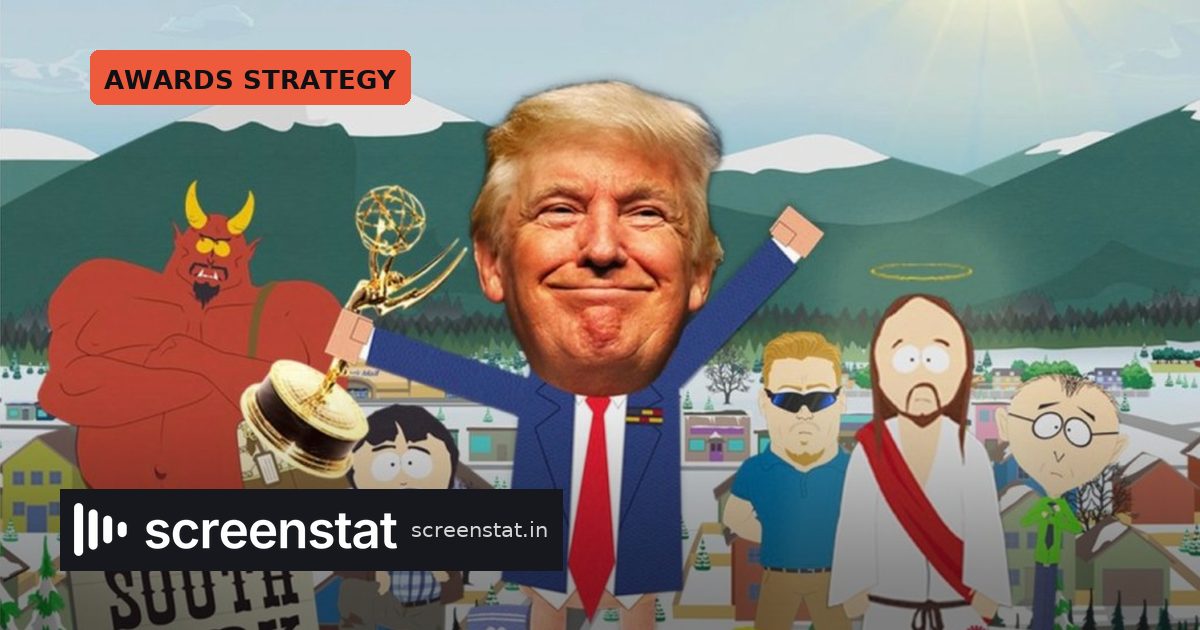
Comedy Central’s South Park won the Outstanding Animated Program Emmy on Sunday — its first win in the category in 13 years, and its first nomination there in five. Then the show did what it has done for three decades: it turned the trophy into a punchline.
The series’ social accounts posted a celebration image of the cartoon Trump, surrounded by South Park characters including Satan, holding an Emmy statuette with his pants down, captioned with a line about him finally getting his Emmy. It’s a jab at Donald Trump’s two Emmy nominations as an executive producer on NBC’s The Apprentice, in 2004 and 2005 — both lost to CBS’ The Amazing Race.
The numbers behind the win
This is the sixth Animated Program win for South Park from 19 nominations in the category — a hit rate a shade under one in three across a run that began in 1997. This year the show landed three Emmy nominations, a record for the series, including a character voice-over nod for co-creator Trey Parker’s work as Satan, plus a Television Academy Honor.
Accepting the award, Parker thanked the audience that has kept the show alive, saying it is “only because of you guys that we haven’t been canceled in 30 years.”
Why a 29-year-old show winning matters commercially
Awards rarely move the needle for a brand-new streaming title on their own. They move it a lot for a deep-library franchise. That’s the business story here.
The eligibility window covered 10 episodes, split into two five-episode runs billed as seasons 27 and 28 — Trump was the recurring target across them, rendered as a photographic head on an animated body. The White House responded at the time by calling the show irrelevant for 20 years and dismissing its ideas as uninspired. An Emmy win is the most efficient possible rebuttal, and it lands nine days before new episodes arrive on Sept. 16.
For media planners and content strategists, the sequencing is the lesson, not the gag:
- Award to premiere gap: roughly a week and a half. Short enough that trophy coverage and premiere marketing share the same news cycle.
- Split-season structure: two five-episode blocks inside one eligibility window keeps a legacy title in conversation twice a year instead of once.
- Free earned media: an official government pushback is distribution you cannot buy, and it validates the satire as current rather than nostalgic.
- Category re-entry: after five years out of the nominee field, a return plus a win resets the perception that the show is coasting on catalogue value.
The relevance flywheel
Legacy animation is one of the most valuable asset classes in streaming — evergreen, bingeable, cheap to re-license and easy to place on ad-supported tiers. But library value decays when a title stops generating new cultural reference points. South Park‘s pattern is a useful framework: topical provocation → controversy → earned media → awards validation → new-episode tune-in → higher catalogue engagement. Each stage feeds the next, and the catalogue is what monetises at scale.
Compare that with animated franchises that keep producing episodes without topical hooks. They still stream, but the discovery has to be bought through carousels and paid marketing. South Park buys its discovery with risk.
What to watch next
Two things worth tracking after Sept. 16. First, whether the Emmy plus the Trump storyline lifts viewing on the back catalogue as well as the new episodes — the standard test of whether awards drive library engagement or just premiere spikes. Second, whether other legacy comedy brands copy the split-season cadence, which effectively doubles a show’s annual news pegs without doubling its episode order.
For anyone selling or planning against animated inventory, that’s the takeaway: relevance, not volume, is what keeps a 29-year-old show winning categories it had stopped being invited to.
Source: Deadline