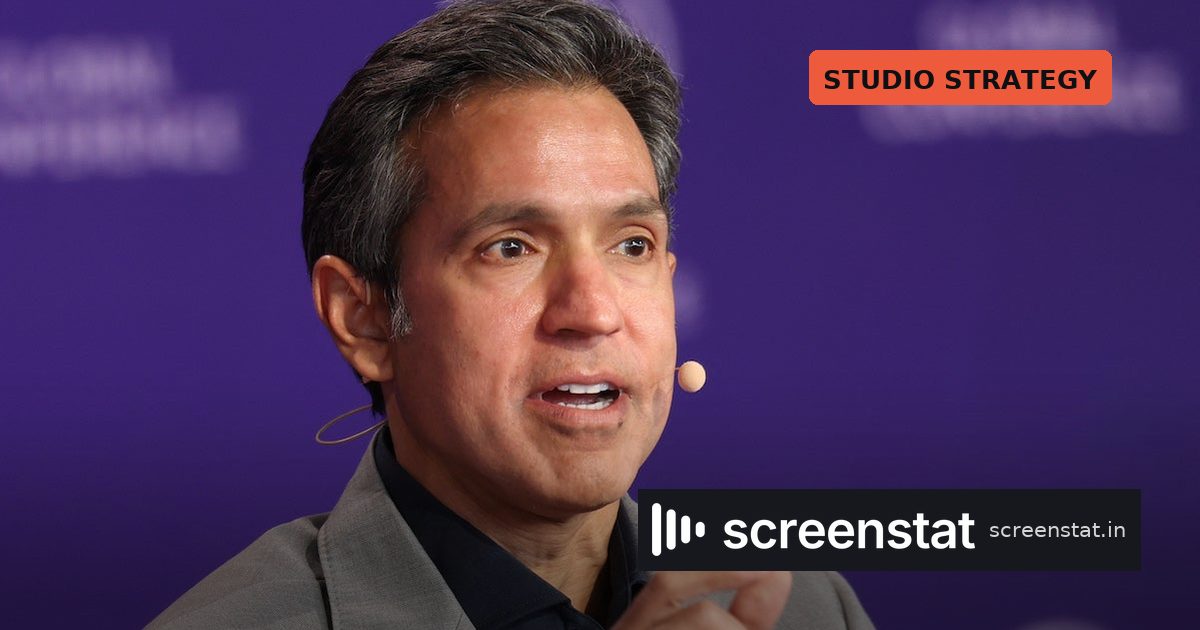
While the rest of Hollywood argues about who buys whom next, Sony Pictures is publicly opting out. CEO Ravi Ahuja told a Bank of America investor conference on Wednesday that the studio has no intention of prioritising large-scale mergers and acquisitions, calling that path “extremely disruptive” to a company’s actual business.
The argument against scale
Ahuja’s case is unusually blunt for a studio chief in a consolidation cycle. Combining large companies with many different business lines can consume years of management attention, he said, and the payoff is often just cost synergy rather than a genuinely stronger operating business. The approval process plus integration work, in his framing, “sets you back for years.”
He went further on the core strategic assumption behind most studio mergers – that bigger content operations produce better content. “These companies are not factories,” Ahuja said, adding that he is doubtful increased scale in content creation makes a big difference. He also said there is no single asset out in the market that Sony feels it must own.
That is a direct challenge to the logic driving the current wave of deals. The industry’s dominant story since 2019 has been that only the largest libraries and the biggest subscriber bases survive. Ahuja’s counter-argument is that the sector is evolving fast enough that a five-to-ten-year positioning question matters more than a balance-sheet one.
Sony did try – and lost
The context matters. Sony partnered with Apollo on a bid for Paramount and lost to Skydance’s David Ellison. Ellison then moved on Warner Bros. Discovery in a $110 billion deal that is currently stalled, facing a lawsuit from a group of 12 state attorneys general.
Ahuja framed the Paramount attempt as consistent with the studio’s stated priorities rather than a contradiction: it was about acquiring IP and capabilities, including in live experiences. Losing that auction, on this reading, did not force a strategy change – it just removed one very large option.
What Sony is buying instead
The alternative is a series of smaller, targeted positions. Recent moves include:
- A majority stake in Peanuts for $457 million – evergreen character IP with merchandising, licensing and animation tails.
- A $100 million minority investment in Cosm, the immersive entertainment company – a bet on out-of-home viewing formats.
- Organic doubling-down on video game adaptations and anime, categories where Ahuja says Sony already leads.
- Capability building on YouTube and other short-form platforms.
Why this matters for the business
Sony has always been the studio without a general-entertainment streaming service of its own, selling content as an arms dealer to Netflix, Disney and others. That looked like a weakness during the streaming land-grab. It looks different now that platform owners are cutting content spend and licensing back to each other.
For media planners and content buyers, the practical read is that Sony intends to remain a supplier rather than a walled garden. That keeps a large, high-quality slate available across platforms instead of being locked behind one subscription – useful for anyone building reach plans across services.
For India-facing readers, the anime and game-adaptation focus is the line to watch. Both categories over-index with young audiences on Indian streaming platforms and YouTube, and Sony owns Crunchyroll-scale anime distribution. A studio that is deliberately not spending years on merger integration has more room to fund that pipeline.
The framework: attention as the real cost
The most transferable idea in Ahuja’s remarks is not financial, it is operational. Mega-deals cost regulatory time, integration time and executive focus – and none of those show up in a synergy slide. In a business where audience behaviour can shift within a single product cycle, spending three years merging back offices is a competitive risk, not just an expense.
The test will be whether a portfolio of $100-500 million IP positions compounds faster than one $100 billion consolidation. Sony has now publicly bet that it does.
Source: TheWrap