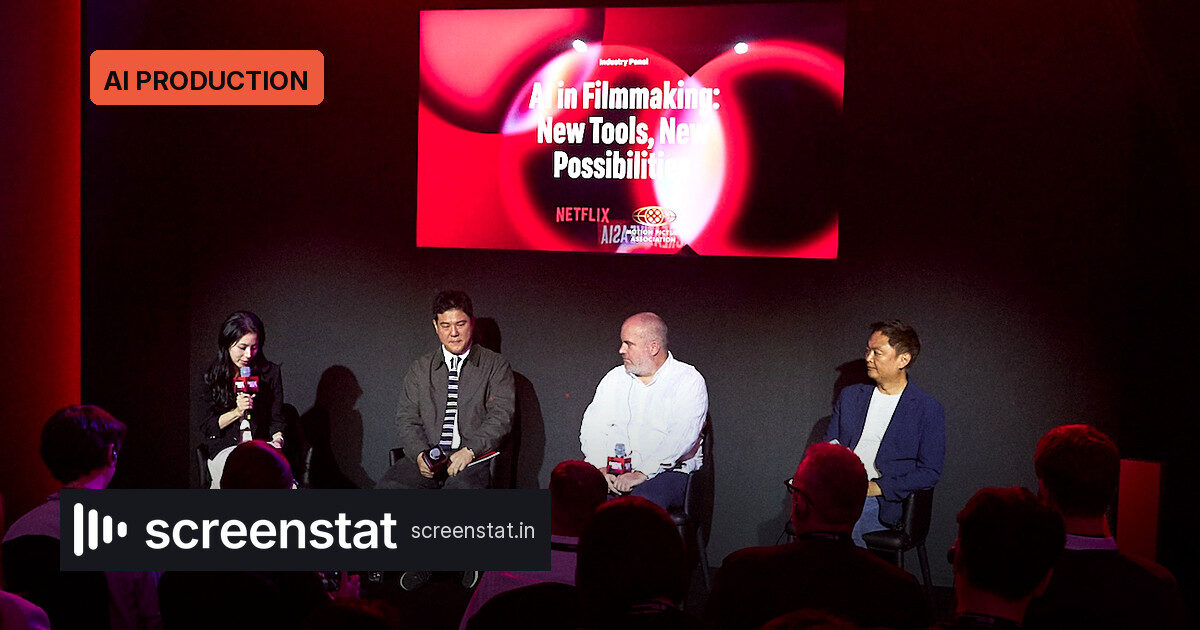
Netflix has given the industry a rare benchmark: about 300 titles have already used AI in some form, according to Sung Q Lee, the streamer’s senior director of production for Asia-Pacific. Speaking at Netflix’s Creative Asia event at the Busan International Film Festival, Lee said the technology now runs through multiple stages of production.
Where the technology is being applied
Lee listed previsualization, production design, set-dressing concepts, editing and VFX as areas where AI is already in use. The more useful question, he argued, is not how much AI a project can absorb but what a project can do with it.
“The question that matters to me isn’t, ‘How much AI can we put into this title?’ but, ‘What more can this title do with AI’s help?’” Lee said.
The cost case from Korea
Korean filmmaker Kang Yun-sung offered the panel’s most concrete number. Kang, director of The Outlaws, is in production on The Gulf of Aden, an action film that uses generative AI tools from China’s Kling AI. He estimated the approach could reduce production costs by around 40 percent.
That saving, he said, comes from streamlining the shoot itself, not just from replacing CG and VFX. His earlier AI-assisted feature Run to the West, billed as Korea’s first fully AI-assisted film, earned only about $100,000 amid negative buzz over its AI visuals.
Kang framed the upside simply: “What has been buried due to budgetary issues was able to be put back on the table.”
- 300 titles: Netflix’s disclosed scale of AI use across production stages.
- 40 percent: estimated cost reduction on Kang’s next action film.
- Assistive, not autonomous: how Netflix and Wētā FX described current AI.
Two markets, two readings
The panel highlighted a split in how the global industry sees AI. The Hollywood creative community remains deeply wary, while parts of the Asian content sector treat it primarily as an opportunity — especially in markets where budgets have held back ambition.
Wētā FX chief technology officer Kimball Thurston said his studio’s current use is deliberately narrow. He called it “assistive AI” that is not allowed to change creative intent. The goal, he said, is to remove repetitive tasks and give directors faster visual references to spot and fix errors.
Netflix’s Lee made a similar point in broader terms: new tools have always changed how films are made, but not why a story needs to be told. Emotion, he said, ultimately requires a human touch.
What this means for the business
For streaming and production executives, the Busan discussion offers a practical frame: AI is being used as a cost and speed lever, not as a replacement for creative leadership. The risk is audience acceptance. Run to the West’s $100,000 result is a cautionary data point that lower cost does not automatically translate into audience trust, especially when the visuals feel synthetic.
The companies that lead this transition will likely be the ones that treat AI as infrastructure — fast visualization, repetitive VFX cleanup, pre-production planning — while keeping final creative decisions with humans. That is the line Netflix and Wētā FX are drawing in public.
Source: The Hollywood Reporter