Japan’s production committee system has long been the industry’s default risk-sharing mechanism: a group of companies jointly finances a film and divides its rights. The trade-off is familiar to anyone who has tried to move a project quickly. Budgets tend to rise only as far as the committee itself can raise, outside investors face structural friction, and decisions can stall when every rights holder must sign off.
A $32 million blind pool takes a different route
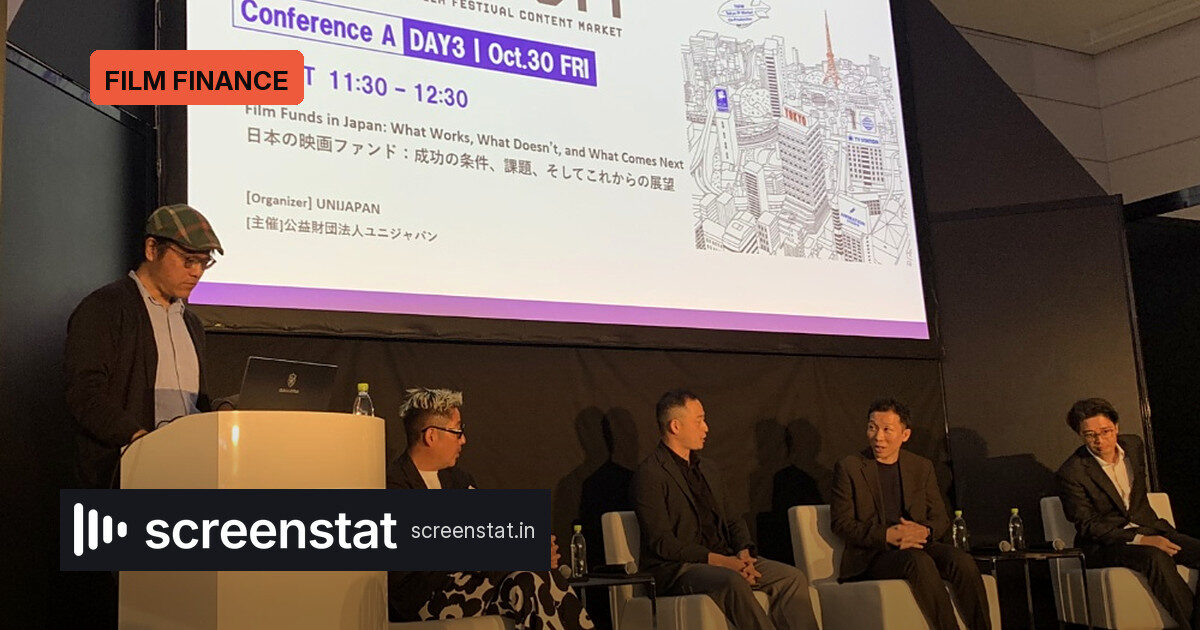
At TIFFCOM, the content market attached to the Tokyo International Film Festival, producers and financiers examined whether film funds can ease those limits. K2 Pictures CEO and producer Kii Muneyuki presented K2P Film Fund I as one live test. The fund closed in February at about JPY5 billion, or $32 million, and is built to back around 50 films over seven years.
It is a blind pool, so investors commit capital before the specific films are selected. A greenlight committee, rather than a full committee of rights holders, oversees project approvals. MUFG, the Development Bank of Japan and other financial institutions and companies are among the investors, and Kii said five films from the fund had already reached theaters in 2026.
Where the money still gets stuck
Kii’s core question is about returns: how to channel money back to creators once theatrical ends and streaming and other windows open. He also cautioned that Japanese companies cannot lean on overseas box office as the default and need to build businesses beyond distribution.
The panel contrasted Japan with the U.S., where producers pair presales with completion guarantees to secure bank loans, and with South Korea, where public-private support and government-backed guarantees help unlock bank financing.
METI puts completion guarantees to the test
MUFG Bank managing director Nakagawa Keita outlined a Japan-specific feasibility study commissioned by the Ministry of Economy, Trade and Industry. MUFG was selected on March 31 to carry it out, and it runs through February 2027. The work uses real-world data to develop valuation and completion-guarantee models and test the process from application and review through contract drafting. The study is about feasibility; it does not promise that financing or completion guarantees will become products.
The TIFFCOM panel closed with four priorities:
- Regulation: clarify which rules should expand, and when.
- Capital: combine debt with subsidies and completion guarantees.
- Creators: build creator returns into fund structures from the start.
- Cross-border business: clear language and tax hurdles such as permanent establishment rules that can make international investors liable for Japanese tax.
What screen businesses should track
For media planners and entertainment marketers, the signal is not that the production committee disappears tomorrow. The signal is that new financing experiments are now being measured with real projects and real release slates. Watch whether K2P’s five theatrical releases convert into downstream returns, and whether METI’s feasibility work produces a bankable completion-guarantee template. Those are the two data points that will tell you if this model scales.
If you are budgeting or partnering around Japanese content, start modeling creator returns across streaming windows early, and do not build your case on overseas box office as the primary recovery source. The Japanese market is testing a more investor-ready structure; the next two years are the proof window.
Source: Variety