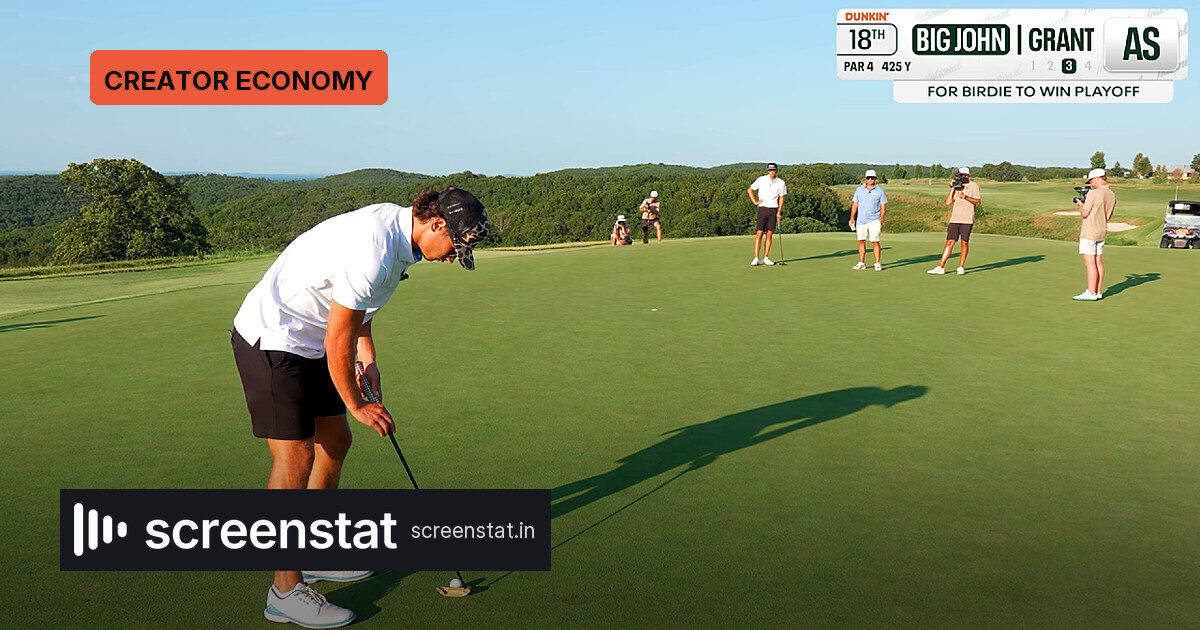
Golf’s most arresting on-screen event this week is not a live PGA Tour stop. It is a pre-taped, team-based YouTube tournament made by Barstool Sports and Bob Does Sports: the second annual Internet Invitational. Its final round premieres Nov. 12 at 1 p.m. ET, and the first five episodes have already drawn 40 million combined views across 17 days of staggered Monday/Thursday releases.
That number does not equal a Nielsen rating. YouTube tallies a view after 30 seconds and counts duplicates; Nielsen reports average minute audience. The context is still striking: this year’s Masters averaged 7 million viewers per round, the U.S. Open 3.9 million, the PGA Championship 3.2 million and the British Open 2.5 million. Creator-run golf is now close enough to major-tournament territory that media buyers and platform leaders cannot ignore it.
What the Internet Invitational actually is
Sixty-four YouTube golf creators filmed the event in August in Missouri, with results protected by NDAs until episodes roll out. The winning trio each takes $1.33 million from a $4 million purse. Robby Berger, the “Bob” of Bob Does Sports, told The Hollywood Reporter the event is a full 50-50 partnership with Barstool founder Dave Portnoy, who put up the money.
The aim, Berger said, is reinvestment: the partners have not taken money out, and the purse has been ploughed back into the tournament. That has raised brand and partnership demand and turned participation into a career accelerant.
- 40 million: combined views across the first five episodes in 17 days.
- $4 million: total purse, with three winners receiving $1.33 million each.
- 64: YouTube golf creators in a taped team format.
- 1.56 million: Bob Does Sports YouTube subscribers; Fore Play Golf has 689,000, Good Good Golf 2.17 million.
Why it matters for the business
The tournament is a talent-development engine. Berger called Big John’s clutch putt “a career changer,” likely to generate more in brand deals than the prize itself. Last year’s winner Brad Dalke picked up a new sponsor immediately, and lesser-known players like Evan Thompson have seen audience spillover. Salim the Dream, after appearing heavily intoxicated in the semifinals, said he is on day 87 of a 90-day sobriety challenge—an illustration of how far the event’s narratives travel.
Berger’s casting rule is “personality above all.” The field is deliberately not the 64 best golfers on YouTube; it mixes high handicaps with stronger players because audiences respond to ordinary people sweating over life-changing money. That is also why Berger is wary of replacing the field with PGA pros, even though serious athletes have asked to join: the stakes only work if money actually matters to the contestants.
What it changes about sports video
Traditional sports value live windows; the Internet Invitational builds appointment viewing with editing, multiple cameras, NDAs and delayed release. Berger said a live final has been discussed, but “if it ain’t broke, don’t fix it.” Four-time PGA Tour winner Kevin Kisner serves as rules official, adding credibility to what is intentionally not a professional event.
For streaming and platform executives, the lesson is that creator IP does not have to imitate broadcast sports to deliver major-scale attention. The audience is showing up for personality, episodic structure and high-stakes storytelling, not live rights.
Source: The Hollywood Reporter