
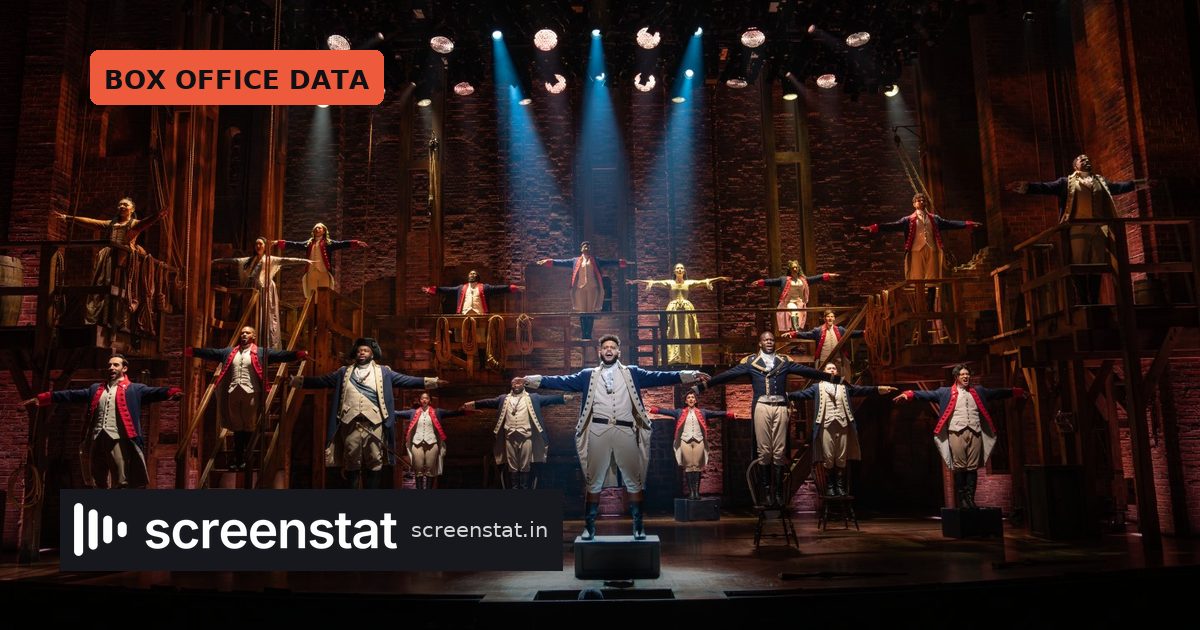
Broadway’s Labor Day week produced a familiar leaderboard and one instructive number. Hamilton was the top grosser at $2 million, and it also carried the week’s highest average paid admission at $204.66 — a reminder that on Broadway, as in streaming, pricing power beats volume.
The week’s top five
- Hamilton — $2 million
- MJ — $1.85 million
- Harry Potter and the Cursed Child — $1.8 million
- The Lion King — $1.7 million
- The Lost Boys — $1.1 million
The new musical The Lost Boys making the top five is the standout entry there. It has been selling steadily since the Tony Awards, which is exactly the pattern producers bank on: awards visibility converting into several months of paid demand rather than a single spike.
Gross up, attendance down — read the split
Industry-wide gross rose 2 percent while attendance slipped 1.3 percent. That gap is the number worth circling. Revenue climbed on a smaller crowd, which means higher yield per ticket did the work.
It also happened with one fewer show on the board, following the closure of Moulin Rouge! on Aug. 30. A shrinking supply of seats with holding demand tends to firm up pricing across the street, particularly for titles already running near capacity.
Labor Day weekend fell inside the reporting week but appears to have moved the needle very little — a useful corrective for anyone who assumes long weekends automatically lift live entertainment. For established Broadway titles, tourist-driven demand is already priced in; the holiday changes the mix of who buys, not necessarily how much comes in.
Capacity is the real signal
Grosses tell you what a show earned. Capacity tells you what it could still earn if it raised prices. Three data points from the week make that clear:
Paranormal Activity, in its first full week after opening, took $790,991 across eight performances while playing to close to 98 percent capacity. That is a strong start on a modest gross — the show is filling the house but not yet monetising it at premium levels.
Oh, Mary! pulled close to $1.2 million at 100 percent capacity as Meg Stalter’s run heads into its final weeks, ending Sept. 12, with Bowen Yang taking over from Sept. 15. Full houses through a cast handover is the cleanest evidence that the show, not just the star, is selling.
The Rocky Horror Show played to 99 percent capacity and grossed $785,875, with attendance ticking up over the past two weeks. Same story: sold out, priced conservatively.
Why this matters beyond Broadway
For media planners and entertainment marketers, the Broadway grosses are one of the few weekly datasets that publishes revenue and utilisation side by side. Streaming platforms report subscribers or hours; theatrical reports revenue. Broadway reports both, which makes it a clean lab for a question every screen business is now asking: do you chase reach or yield?
A simple framework to apply to any title, on stage or on a platform:
- High capacity, low yield (Paranormal Activity, Rocky Horror) — demand exists; pricing or premium tiers are the lever.
- High capacity, high yield (Hamilton) — the mature franchise position; protect it, don’t over-extract.
- Low capacity, high yield — narrow, affluent audience; marketing needs to widen the funnel.
- Low capacity, low yield — the exit signal, and effectively the story behind any closure.
Applied to Indian OTT, the parallel is direct. Platforms sitting on near-full engagement but low ARPU are in the Paranormal Activity quadrant — the audience is there, the price isn’t. A 2 percent revenue gain on 1.3 percent fewer customers is not a warning sign. It is what a business looks like when it stops selling on volume.
Source: The Hollywood Reporter