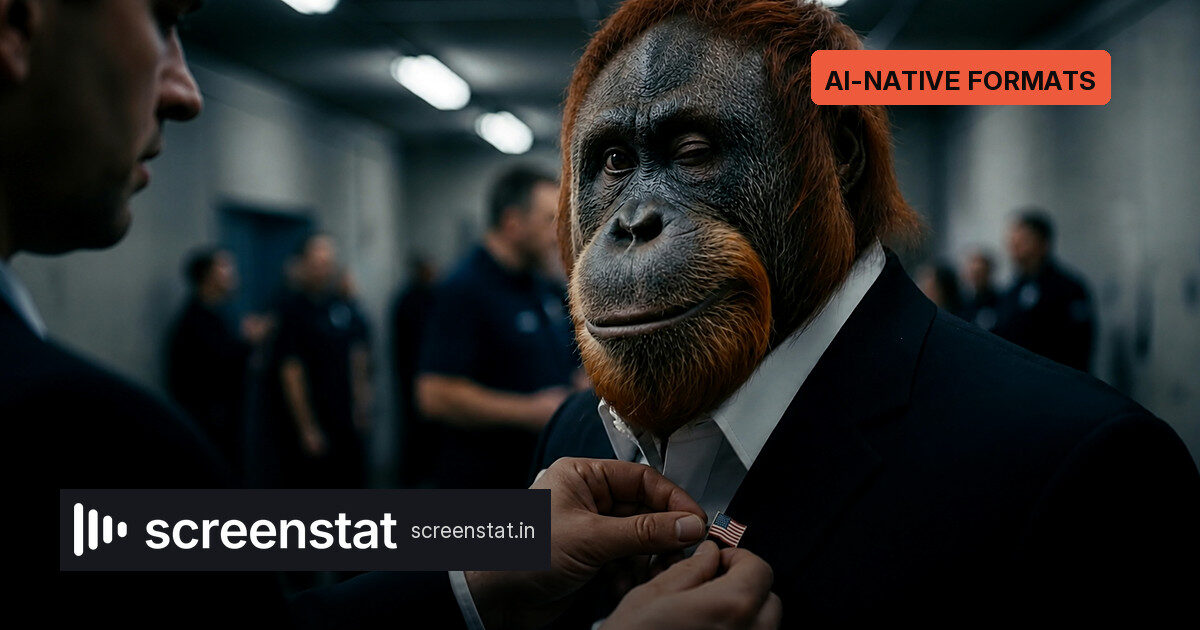
BriskPace Studios has drawn a clear line for AI-native entertainment: it can be strange, but it still needs a human showrunner. At MIA in Rome, the German company launched BriskPace Unlimited, a new label for formats it calls “bonkers,” and gave it a debut original about an imprisoned orangutan with a political past.
The show, The Light and Hard Times of Lucky Briscoe, is a true-crime comedy that follows Lucky from Communist Romania to sitcom stardom, cult leadership and federal prison. The pilot is complete and uses AI-generated imagery and music — a deliberate proof point for how the label wants to work.
Known comedy voices, machine-made assets
The team behind the pilot is where BriskPace is borrowing credibility from traditional television. Jason Hazeley, a writer on BBC’s Cunk on Earth, is showrunner. Joe Markham, whose credits include The Amazing World of Gumball, is writing. Al Munteanu created the series and co-directs with Tom Paton, founder of AiMation, the AI studio the new label part-owns.
Munteanu’s pitch for the production model is deliberately blunt: “We kept our heads down for a year and built something truly bananas.” He added that people made the decisions and “the machines did what they were told. Mostly.”
Hazeley described the tone as “Adam Curtis meets Chuck Jones” — a satirical state-of-the-nation view colliding with animated physical comedy. Paton’s framing is simpler: “The technology is just technology; what matters is whether it’s funny.”
Where the label is placing bets
BriskPace Unlimited is not only a production arm for one pilot. It is built to develop AI-native titles, micro-dramas and creator-led formats alongside the main BriskPace Studios film and TV slate.
- AiMation: minority stake; co-producer on Lucky Briscoe.
- Sweetz: seed investor alongside Groupe M6 in the French micro-drama app from AI studio Nation and app publisher Kovalee.
- Snips: investor in the Israeli platform that turns full film and TV titles into vertical micro-episodes; it launched in August with Banijay Rights and BIG Media catalogue deals.
Why buyers should watch the routing, not just the ape
For commissioning and planning teams, the meaningful detail is distribution. Munteanu said the series is going to buyers and direct to audiences, with both routes built this year. That matters because AI-native titles often arrive with a technology story first and an audience story second. If a finished pilot can carry its own direct audience signal, it changes the conversation with platforms from “trust us” to “look at the numbers.”
The label’s wider portfolio points in the same direction. Micro-dramas and vertical micro-episodes are formats built for mobile viewing and ad-supported windows, where cost per finished minute and audience proof matter more than theatrical prestige.
For media planners and entertainment marketers, the immediate takeaway is simple: judge AI-assisted content on the same criteria you would apply to any comedy pilot — whether it is actually funny, how it is packaged, and what evidence accompanies the pitch. The technology is a production decision; the marketing challenge remains the same.
Source: Deadline