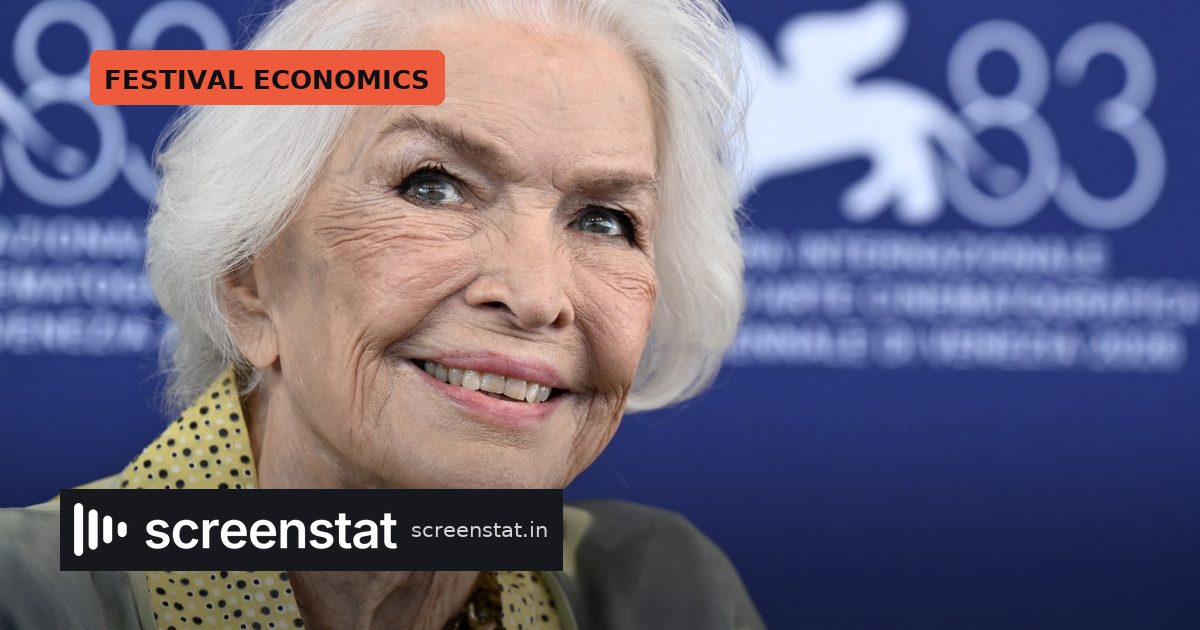
Ellen Burstyn arrived at the Venice Film Festival with two titles in hand and an honorary Golden Lion waiting for her at an evening ceremony. At 93, she is not doing a victory lap so much as running a second production slate.
What she is presenting
Burstyn plays an imagined, elderly version of Marilyn Monroe \u2014 the star as she might have been had she lived into her 90s \u2014 in Flesh Impact, a short film directed by Maggie Gyllenhaal, whose feature The Bride! also carries her name this cycle. Dakota Johnson appears as the younger Monroe in flashbacks.
She also features in Korn\u00e9l Mundrucz\u00f3’s drama Place to Be, screening out of competition, as an older woman who forms a friendship with a divorced middle-aged man played by Taika Waititi. Burstyn described the film as a love story without a sexual relationship, and said she expects audiences to respond to exactly that.
Burstyn told reporters she saw Monroe only once, across a nightclub table, before she joined the Actors Studio in New York. Monroe nodded at her. \u201cI’ve just been recognized by Marilyn Monroe,\u201d she recalled thinking \u2014 a moment she says she has carried since.
Why a festival honor matters commercially
Lifetime achievement awards look ceremonial, but they function as distribution infrastructure. A Golden Lion moment gives a short film and an out-of-competition drama something neither can buy: a news cycle, festival press access, and a reason for acquisitions executives and streaming curators to book a screening. For titles without a wide-release plan, that attention is the marketing budget.
For media planners and acquisitions teams, the practical read:
- Shorts have a home again. A Gyllenhaal-directed short starring Burstyn and Johnson is exactly the kind of asset streaming services use to signal prestige at low cost.
- Older-skewing casts are not a liability. A relationship drama built on a 93-year-old lead and Taika Waititi targets an audience segment that television has long monetised and film has underserved.
- Festival honors travel. Coverage of a Venice tribute reaches markets, including India, where neither title will get a theatrical push \u2014 building awareness ahead of any eventual platform window.
The Alice lesson: leverage is the real greenlight
The most useful part of Burstyn’s Venice remarks, for anyone in development, was her account of how Alice Doesn’t Live Here Anymore came about. After The Exorcist, then-Warner Bros. chief John Calley told her agent the studio wanted another film with her. The scripts that followed, she said, were full of women she did not recognise \u2014 supportive figures handing a cup of tea to husbands who had gone off to save the world.
So she countered: she wanted a film about women as she knew them. She then picked a largely unknown director with one feature to his name \u2014 Martin Scorsese. The company rehearsed and improvised the next day’s scene at the end of each shooting day, and the script, in her telling, grew into a film credited with shifting how women saw themselves. It won her the Academy Award for best actress in 1974.
The mechanism is worth naming, because it still applies: a proven commercial asset converted studio demand into creative control, and used it to change the product. That is a repeatable playbook, not nostalgia.
The crew story is a data story
Asked how Hollywood had changed for women, Burstyn was blunt: enormously. When she started, she said, there were no women in the crew at all \u2014 if a woman was on set, she was an actress. Change came job by job: a script supervisor, then a camera assistant, then integration across departments.
She was less sentimental about The Exorcist. William Friedkin was extremely talented, she said, but also a director who would do anything to get a shot \u2014 including, in her case, a back injury she believes she should never have sustained. It is a reminder that on-set safety is a production cost, not a footnote.
Her advice to younger actors came second-hand, from Bette Davis: the work is the only thing that matters, and anyone who gets between you and it is an enemy.
Source: The Hollywood Reporter