
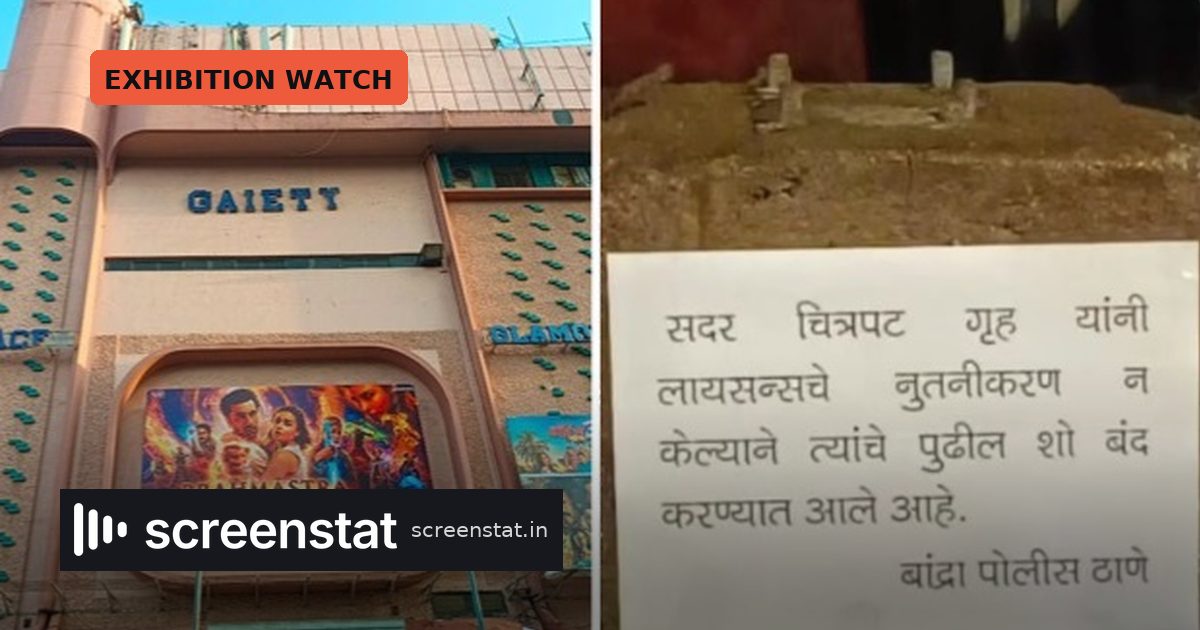
One of the most-watched cinema addresses in Indian film distribution has gone dark. Gaiety-Galaxy, the Bandra complex better known in the trade as G7, has temporarily stopped screening films after its licence was not renewed, according to a report by bollywoodHungama.com.
The report cites a post by journalist Narendra Gupta, who shared an image of a notice from the Mumbai Police pinned outside the theatre gate stating that the cinema had been closed because the management had not renewed its licence. The complex was reportedly running shows as recently as Sunday, September 6, and stopped the following day. All screens are shut until further notice.
Bollywood Hungama said it attempted to reach Manoj Desai but he was unavailable for comment. Trade sources quoted in the report indicated the management is working to resolve the matter and that a fix is expected soon.
Why one single-screen closure is a trade story
On pure capacity, G7 is a rounding error in a national box office that now runs on thousands of multiplex screens. On signal value, it is anything but. Gaiety-Galaxy has functioned for decades as the industry’s unofficial audience-testing lab: an affordable, high-footfall, mass-audience venue a short walk from Bandra station, where stars have historically turned up on release day to watch first-day reactions in person.
That makes it a reference point rather than a revenue line. Trade commentators, distributors and marketing teams routinely read opening-day energy at G7 as a proxy for how a mass-market Hindi release is landing with walk-in audiences rather than pre-booked multiplex crowds. Lose the venue for even a few weekends and you lose a qualitative read that no dashboard replaces.
What the complex actually is
Per the source, the details are worth restating because they explain the venue’s outsized role:
- Opened on November 24, 1972, with Ramesh Sippy’s Seeta Aur Geeta as the inaugural film.
- Started with three theatres: Gaiety, Galaxy and Gemini.
- Gaiety is the largest at close to 1,000 seats; Galaxy is around 800; Gemini has roughly 240.
- Four more were added in the late 1990s: Grace, a preview theatre above the Gaiety balcony that is not open to the public; Gem, beside Galaxy’s stalls; Glamour, a roughly 45-seater built between Galaxy’s stalls and balcony; and Gossip, a 105-seater with a separate rear entrance.
Add it up and the public-facing capacity sits in the low 2,000s across screens, with a single-day gross that a large multiplex can match. The influence comes from the mix of scale, price point and location, not the arithmetic.
The operational lesson for exhibitors
Cinema exhibition in India sits on a stack of statutory permissions covering premises, fire safety, public performance and local licensing. Any one of them lapsing can stop shows instantly, regardless of how many advance tickets are sold or how strong the weekend slate is. For older single-screen properties operating on thin margins, compliance calendars are as much a business-continuity issue as programming is.
Three practical takeaways for anyone with money in the exhibition chain:
- Distributors: build screen-level contingency into release planning for heritage venues, especially in week-one allocations.
- Marketers: if your qualitative audience read leans on one venue, diversify it before you need to.
- Operators: treat licence renewal dates like release dates, with owners and reminders attached.
The expectation in the trade, per the source, is that this is a short interruption. But the episode is a reminder that India’s single-screen base, already shrunken, remains fragile in ways the multiplex circuit is not.
Source: bollywoodHungama.com