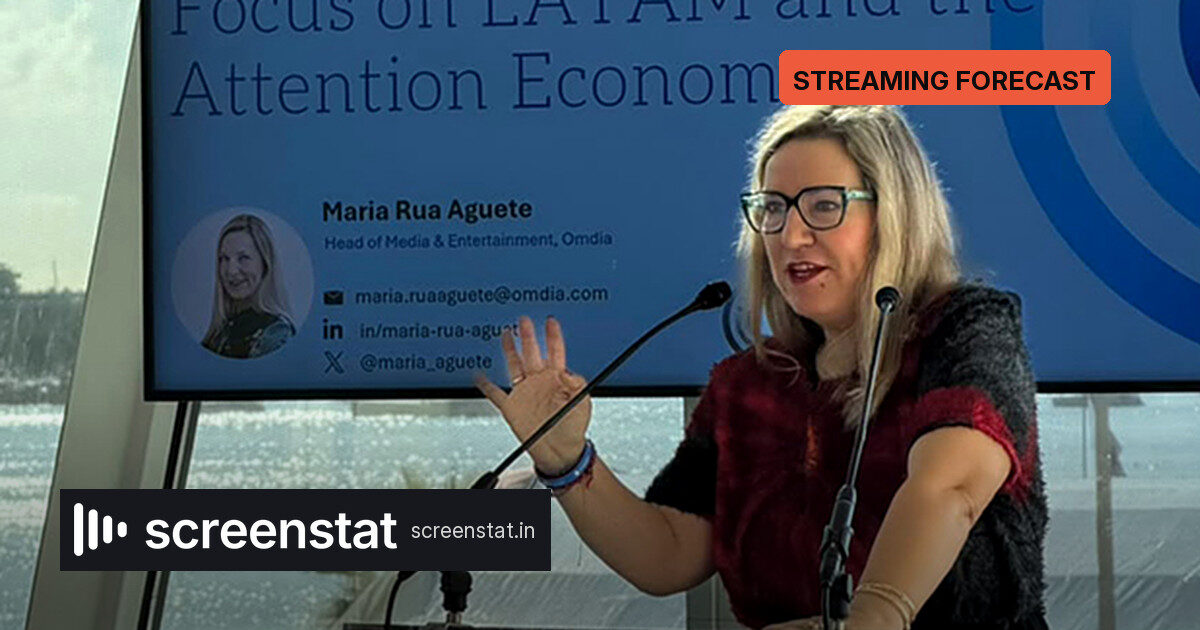
Short-form video has crossed a symbolic line. At the LatAm Partnership Summit in Cannes, Omdia’s María Rúa Aguete said YouTube Shorts alone is already bigger than Netflix in the US, with the same pattern visible in the UK, Brazil and Spain.
That does not mean YouTube replaces Netflix in every use case. But it does mean reach planning can no longer begin and end with premium long-form video.
The short-form signal
For media planners, the claim matters because the US is the deepest premium streaming market. If short-form already beats Netflix there, the volume is not a peripheral behaviour—it is a primary video habit.
Rúa Aguete called the scale “food for thought”, and the fact that Brazil and Spain show the same trend means this is not simply an English-language or high-penetration anomaly. Short-form inventory is becoming a default reach layer.
For advertisers, that changes the conversation. Short-form platforms offer fast-frequency, vertical creative and lower production thresholds, but they measure attention differently from long-form drama. The planning question is how to split brand-building from performance without double-counting reach across formats.
Latin America’s $62bn growth path
Omdia also sized Latin America, forecasting media and entertainment revenue of US$62bn in 2026, up 15.4%. The composition shows where attention and money are moving:
- Online video: US$35bn
- Traditional television: US$16bn
- Video games: US$5.9bn
- Music: US$3bn
- Cinema: US$1.8bn
Streaming penetration remains low at 35%, equal to 190.7 million subscriptions in 2026. Omdia expects subscriptions of 208.7 million in 2027 and 243.5 million by 2031. Netflix remains the region’s largest single service, with a forecast 63.8 million subscriptions in 2026 rising to 73.7 million by 2031, and it captures almost half of subscription streaming revenue.
Rúa Aguete said Netflix’s ad-supported plan is helping it reach new audiences while strengthening market leadership—another sign that ad-supported access is the growth lane, not the discount lane.
The gap is connectivity, not demand
The sharpest framing for operators is that Latin America has no television problem but a connectivity challenge. Television reaches 91% of the region, while subscription streaming reaches only 35%. The next phase depends on affordable access, content that reflects local audiences and partnerships, not on transplanting a US or European playbook.
For streaming and advertising teams, that makes Latin America both a growth case and a design problem. The market rewards lower-priced and ad-supported entry, investment in local content, and distribution through partners who already own the connectivity relationship. It also rewards marketers who treat Latin America as a collection of distinct markets rather than one regional template.
Source: C21media