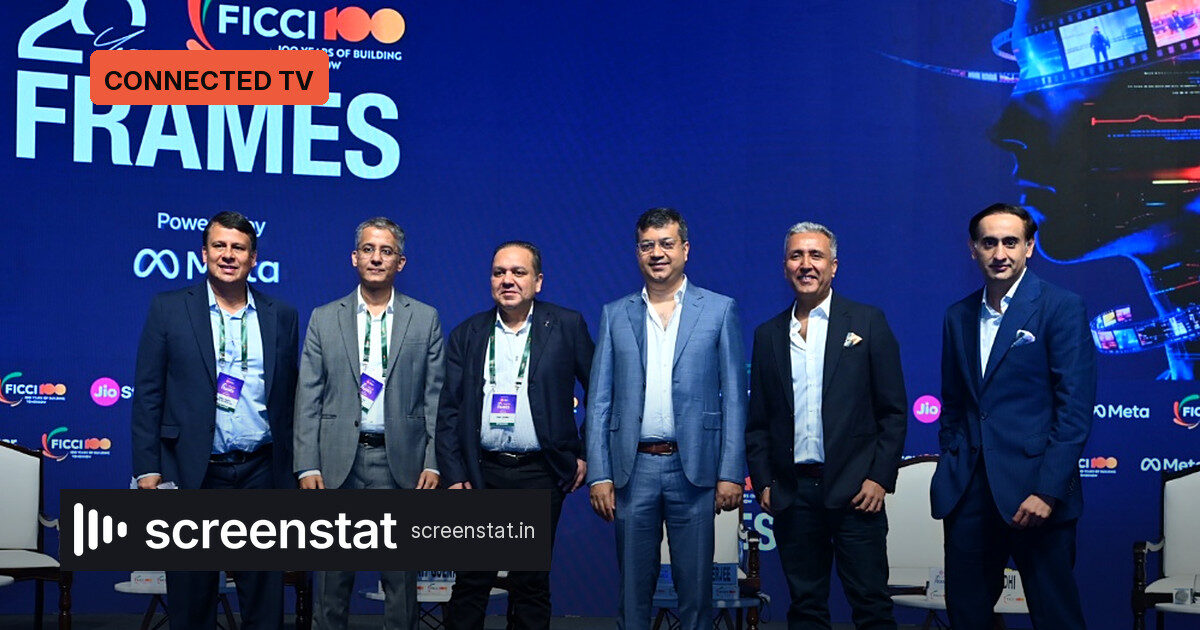
Connected TV is no longer just a distribution channel for Indian streaming. At FICCI-Frames in Mumbai, executives from Prime Video, JioStar, Sony Pictures Networks India, Zee Entertainment and NDTV made the case that the large, addressable screen is starting to shape what gets commissioned in the first place.
Prime Video’s Asia-Pacific and Australia-New Zealand head Gaurav Gandhi said his teams increasingly separate projects into two buckets: “a co-viewing show” versus “an individual-driven show.” The shift combines television’s shared lean-back viewing with digital’s convenience, choice and targeting. But it also exposes a discovery problem: in a lean-back environment with endless choice, recommendation engines have to improve if viewers are to find anything at all.
CTV economics move beyond the remote
JioStar entertainment CEO Kevin Vaz preferred to focus on the large screen rather than the acronym. The large screen has historically been “communion” and a “unifier” for families, he said; CTV keeps that role while adding measurement and addressability. He put India’s CTV audience at nearly 200 million viewers, growing fast, which matters because most advertisers still prefer the bigger screen.
Sony Pictures Networks India MD and CEO Gaurav Banerjee invoked the old line “Medium is the message” and cautioned against getting distracted by the signal. The real question, he said, is what people do when they get to the large screen. For him, the core opportunity is the same as television has offered for three decades: a family gathered around a show they can discuss over dinner.
Niche formats find room on CTV
For NDTV, connected TV is unlocking programming that linear schedules could not justify. CEO and editor-in-chief Rahul Kanwal said channels typically avoid narrow-appeal shows because they can drag down ratings. On CTV, NDTV has backed “Lifeline” on healthcare, wellness and anti-aging, and “Launchpad” on upskilling, because viewers only open such content if they are already interested.
Vaz also said the definition of a hit has changed. Success is no longer a single large-screen rating; it now includes audience votes, engagement and social trends. Technology can match each story to the viewer it suits, so “one person’s flop can be another’s hit.” But Zee Entertainment CEO Punit Goenka offered a blunt caveat about the abundance: “Infinite content does not mean infinite consumption.”
What this means for media planners
The takeaway for entertainment marketers and planners is to stop treating CTV as either television or digital. The buy-side opportunity is both: TV’s scale and shared context, plus digital targeting. The creative and measurement brief has to follow.
- Brief premium CTV creative for shared viewing, not solo mobile attention.
- Use CTV inventory for addressable brand reach against a large-screen audience.
- Treat discovery and recommendations as a conversion problem, not a search problem.
- Benchmark a hit on rating plus engagement and social, not one panel number.
If the large screen is becoming addressable without losing its communal role, the next wave of Indian streaming will be built around formats that families choose together, and around discovery systems that do not bury them.
Source: Variety