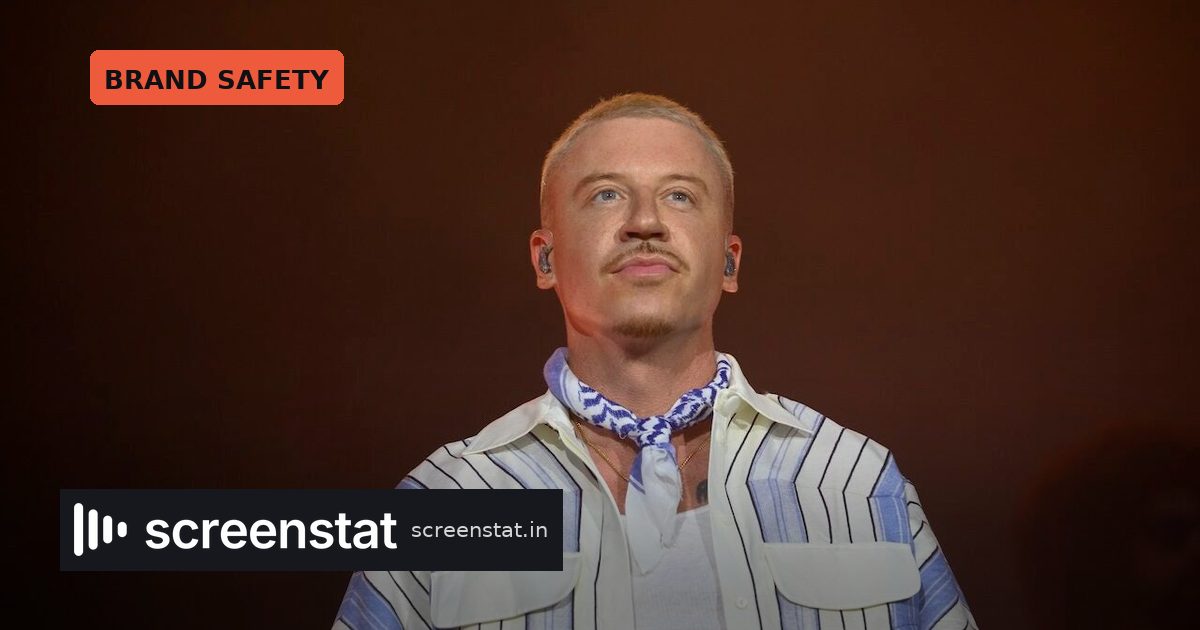
Macklemore used his second night opening for Ed Sheeran at MetLife Stadium to clarify that his onstage call to “free Palestine” was not aimed at Jewish audiences. Addressing what he called his “Jewish brothers and sisters,” the rapper said criticism of Israel and opposition to genocide is “in no way a criticism” of them, adding that his “message is for peace, love” and for all people to be treated with dignity and equality, according to TheWrap.
He went on to list Lebanon, Cuba, Congo and Sudan, and referenced people in the United States living in fear of immigration enforcement, closing with the line that none of us will be free until we are all free.
What actually happened
The sequence matters more than the soundbite, because it is the sequence that media and marketing teams now have to plan for.
- Macklemore made an initial “free Palestine” statement from the stage during the Sheeran stadium run.
- The Israeli American Council responded with a petition, circulated on Saturday, calling for his removal from all tour dates.
- The petition did not change the schedule. He performed as planned on Sept. 5.
- He posted video of his opening remarks to Instagram on Monday, writing that wanting all humans treated equally should never be controversial.
- On the second night, he issued the clarification and introduced “Hind’s Hall,” the track named after the Columbia University building occupied by pro-Palestinian student protesters, itself named for Hind Rajab, the five-year-old Palestinian girl killed by the IDF.
Why a stadium moment is now a platform story
Twenty years ago, an onstage political statement reached the people inside the venue and whoever read the review. Today it reaches the venue, then the artist’s own Instagram, then every clip account that re-cuts the vertical video, then the reaction economy on top of that.
That is the structural change worth internalising. The artist controls the first-party post. Nobody controls the second-order distribution. Macklemore’s own Instagram upload is the reason his exact framing survived the news cycle rather than a 12-second crop, and it is why the clarification on night two landed as a statement rather than a walk-back.
For anyone buying around live music, sponsoring tours, or licensing concert content to streaming services, this is the operating reality: a support act’s four-minute intro can generate more distributed video than the headliner’s set.
The pressure-to-drop playbook, and its hit rate
The removal petition is a familiar instrument. Advocacy groups on every side of every issue use it because it is cheap, fast and generates coverage even when it fails. What it rarely does is change a tour manifest mid-run.
The economics explain why. Stadium tours are contracted months ahead, with support slots locked into routing, production and settlement terms. Removing an opener between dates creates immediate financial and logistical exposure for the promoter, and hands the removed artist a much larger platform than the one they were using. The path of least cost is almost always to let the run continue.
Media planners should read petition volume as a signal of noise, not a predictor of outcome. The useful question is not “will they be dropped” but “how long does this stay in the feed,” which is usually a matter of days unless a brand or platform intervenes and restarts the clock.
What to do about it
Three practical takeaways for teams with money on live entertainment:
Separate headliner risk from support risk. Sponsorship contracts often treat the tour as one asset. The commentary risk sits disproportionately with openers, who have less to lose and more incentive to be memorable.
Have a no-comment default. A brand statement about an artist’s political remarks converts a music story into a brand story. That is a self-inflicted extension of the news cycle.
Assume every minute of stage time is publishable. If your logo is on the screen behind the artist, it is in the clip.
None of this settles the underlying argument, which is not a media-planning question. But the distribution mechanics around it are, and they are getting faster.
Source: TheWrap