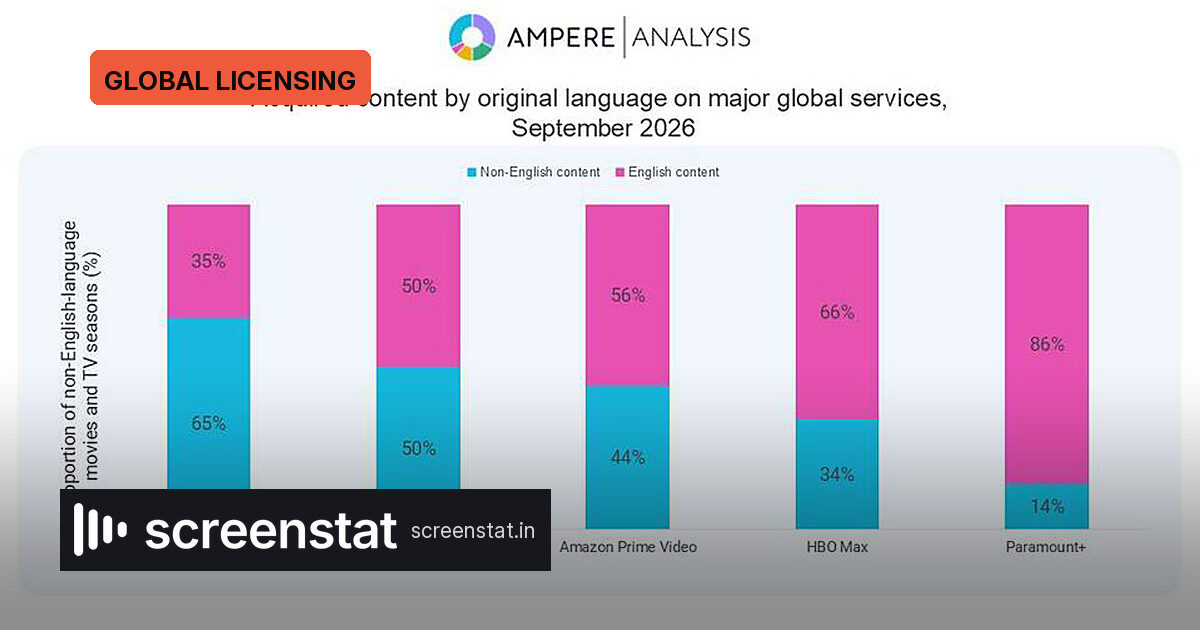
Non-English-language titles now dominate what global streamers license, according to new Ampere Analysis data. As of September, 65% of the titles Netflix acquired were non-English; Disney+ was at 50%.
The acquisition mix
Netflix is leaning most heavily on Japanese and South Korean content. Disney+ is sourcing its non-English titles mainly from Germany and Japan, the research firm reported.
Ampere points to Japanese, French, South Korean and Turkish content as the strongest opportunities, measured by how many titles travel internationally and how much audience demand they generate.
- Netflix acquisitions: 65% non-English, with Japan and South Korea leading
- Disney+ acquisitions: 50% non-English, with Germany and Japan leading
- Japanese VoD catalog: only 40% is available internationally
- English-language content: only 5% is exclusive to its home market
The distribution gap
The Japanese figure is the clearest signal. Just 40% of Japanese VoD content is available outside the country, with science-fiction, fantasy and anime the most exported genres. By contrast, only 5% of English-language content stays locked to one market. English libraries are already global; high-demand non-English catalogs still have room to run.
Ampere’s read: global content gives streamers a way to grow audiences and satisfy demand for diverse programming. Tingting Li, research manager at Ampere, said in a statement: “Non-English content remains underexploited despite growing global demand. In recent years, Amazon Prime Video, HBO Max and Disney+ have increasingly expanded non-English-language title licensing in multiple markets.”
Li added that buying Japanese, South Korean, French and Turkish content “can bridge the gap between audience demand and international distribution.”
What it means for the business
For media planners and entertainment marketers, the data changes the default. The next breakout import is not necessarily another Korean drama; it may be a Japanese sci-fi title or a Turkish drama that hasn’t yet travelled. Platforms that license these catalogs can acquire audience without bearing full production risk, while content owners can unlock cross-border revenue.
A simple screen for buyers
Ampere’s method is effectively a gap screen: count titles exported internationally, then weigh their popularity. Content that scores high on popularity but low on cross-border availability is the opportunity. Acquisition teams can use that ratio to prioritise libraries before chasing the next proven hit.
In related news, Netflix chief Ted Sarandos said the recent executive changes at the company are not a wholesale content strategy reset but a push for a stronger US programming slate. That internal move sits alongside, rather than replacing, the platform’s growing international licensing appetite.
Source: C21media