
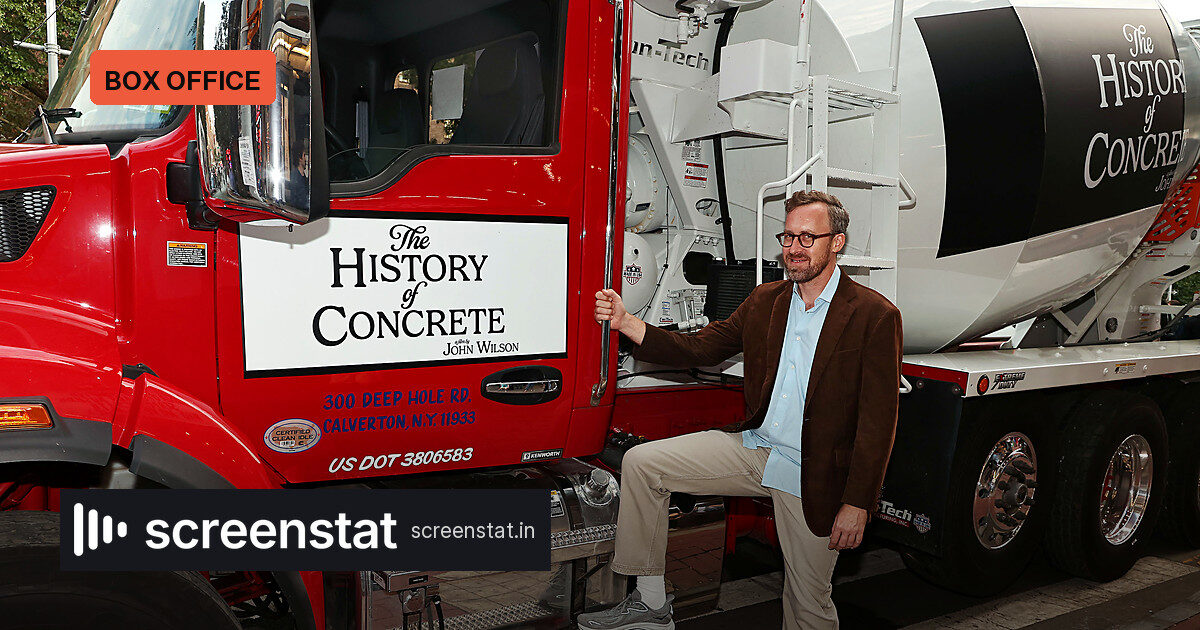
Sixteen days into its theatrical run, Magnolia Pictures’ “The History of Concrete” has crossed $1.2 million in North American grosses, according to weekend estimates cited by IndieWire. The film passed the $1 million mark on Saturday, making it the highest-grossing platform-distributed documentary of 2026.
That is a deliberately narrow category, but it is the right one. “The History of Concrete” is not competing with wide documentary releases; it is being measured against titles that opened in a handful of theaters and expanded on word of mouth.
Why a platform release worked
John Wilson, creator of HBO’s cult favorite “How To with John Wilson,” made an absurdist film that examines architecture and concrete. Magnolia acquired it out of Sundance. Over the weekend, the film grossed just over $450,000 from 160 screens, lifting its total to just north of $1.2 million.
That total is big for a documentary, but the more instructive numbers are at the venue level. Last week, it earned $47,510 at the Music Box in Chicago, $34,534 at BAM in Brooklyn, and $24,653 at the Balboa in San Francisco. Wilson’s own Low Cinema in Ridgewood, Queens, has sold out every show through the end of October.
- IFC Center record: second-highest-grossing debut behind “Parasite.”
- 16 days to $1M: the speed signals demand beyond opening weekend.
- Younger audiences: the same demo driving the 2026 cinema comeback.
What it means for specialty film
The comparison set matters. “Melania” has grossed $16.7 million, and Neon’s “EPiC: Elvis Presley in Concert” has earned $13.6 million domestically, but those opened wide or in hundreds of Imax theaters. Among platform-style documentary releases, “Mary Oliver: Saved by the Beauty of the World” earned $773,430, “Steal This Story, Please!” netted $750,077, and “American Doctor” earned $556,703. “The History of Concrete” has already cleared all three.
For entertainment marketers, the numbers provide a counter to the assumption that documentaries need celebrity subjects or major marketing budgets. Wilson’s built-in audience did the acquisition work; Magnolia’s job was to give them venues where demand could be measured.
The lesson: in specialty distribution, concentration is a strategy. A national screen count of 1,963 or 1,778 can produce bigger grosses, but it also creates fixed marketing and distribution costs. Platform releases let per-screen data set the upper limit of spend.
The next test is whether the run continues to expand. The current weekend gross of $450,000 from 160 screens implies a per-screen average around $2,812, enough to justify more screens in the coming weeks.
Source: IndieWire