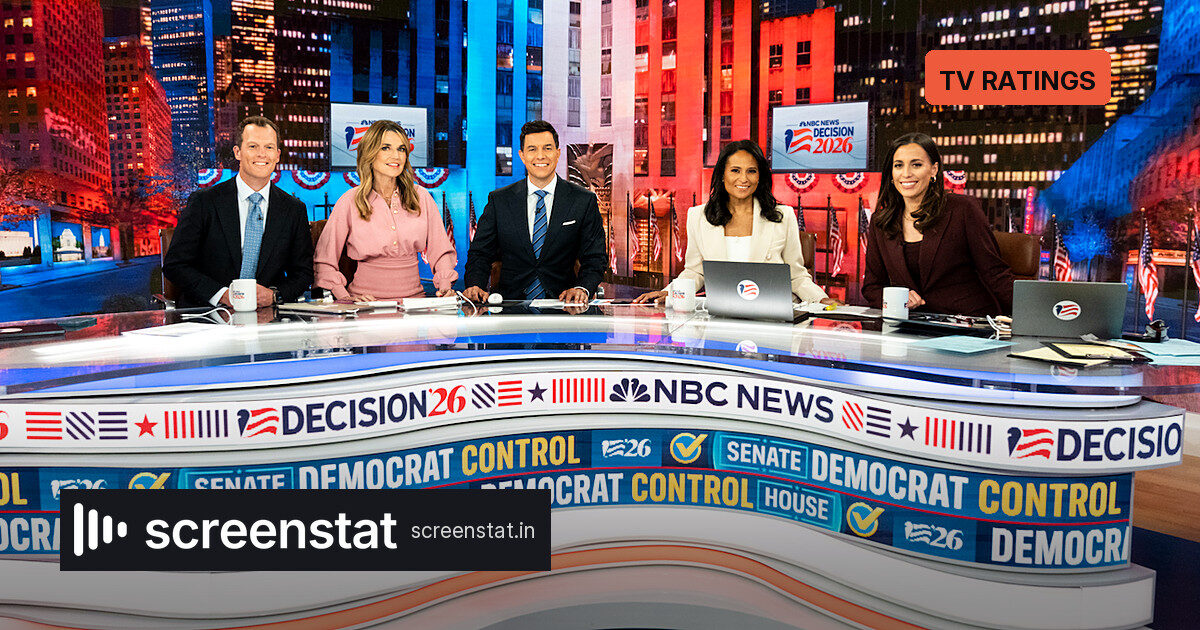
Election night didn’t just redraw the political map—it redrew the television map. Nielsen data from Tuesday’s midterm coverage shows broadcast networks captured 57% of the 31.21 million people watching primetime returns across 13 outlets, while cable took 43%. That is the reverse of the 2022 split and the first time in six election cycles that broadcast has held the majority.
The primetime pecking order
Total viewing was up: 31.21 million viewers, against 25.43 million in 2022. The broadcast total of 17.79 million people was spread across six networks:
- NBC: 6.74 million, more than double its 2022 average
- ABC: 5.19 million, up 57%
- CBS: 2.76 million, up 8%
- Univision: 1.54 million; Telemundo: 1.06 million; PBS: about 500,000
NBC led all networks—the first time a broadcaster has done that since NBC did it in 2012. Cable’s biggest name moved the other way: Fox News lost almost 3.5 million viewers from 2022. The three big broadcasters together added more viewers than Fox News shed, so this wasn’t simply one cable channel’s bad night.
Why the balance moved
The structural story is cord-cutting. Households with a multi-channel service—cable, satellite, or a digital bundle like YouTube TV or Hulu + Live TV—now make up 42.5% of TV homes, down from 52.3% four years ago. That’s a loss of more than 10 million households, which shrinks cable’s available base before a single vote is counted.
There’s also an audience-strategy lesson. ABC and NBC positioned themselves as big-tent destinations, while Fox News and MSNBC lean into partisan lanes. NBC News executive Marc Greenstein told The Hollywood Reporter that its reporting tries to move beyond the “left-right food fight” and focus on substance and common ground. His framing: NBC does big events—Super Bowl, Olympics, election night—well, and its scale and weight matter on these nights.
The second screen is now part of the ratings story
NBC didn’t win only on linear. Its Kornacki Cam live stream of political analyst Steve Kornacki was the most-watched live stream of election coverage. NBC News led all election-night streaming with 4.39 million hours on its YouTube channels, per Streams Charts; Twitch streamer Hasan Piker was second at 1.75 million hours. The technical setup used audio-filtering software from Waves to run Kornacki’s stream near the main desk without interference, turning a companion feed into reinforcement for the broadcast.
What this means for planners
The midterm number is a reminder that live events still aggregate a broad, simultaneous audience, but the source of that audience is shifting. Broadcast is gaining relative share partly because pay-TV’s universe has shrunk, not because cable audiences vanished. For media buyers, election night offers a clean template: buy the big-tent linear reach, and treat companion streams as a separate, additive inventory rather than an afterthought.
The question to track over the next cycle is whether broadcast’s 57% holds when the political mood changes—or whether this was partly a one-night function of which side’s audience stayed home.
Source: The Hollywood Reporter