The debate over how to fund the BBC now has a headline figure: £1.6bn (US$2.1bn). Extending the UK TV licence fee to streaming households could raise that much more for the broadcaster by 2032, according to modelling by Ampere Analysis, assuming the fee is collected from every eligible home.
Ampere’s research, due in December as part of its BBC funding report, lands as the government prepares its Charter Review White Paper. The work starts from a simple mismatch: in Q3 2026, well over 90% of UK households watch licensable content, but the BBC’s own figures show only 84% of eligible households pay the licence.
Two scenarios, one direction
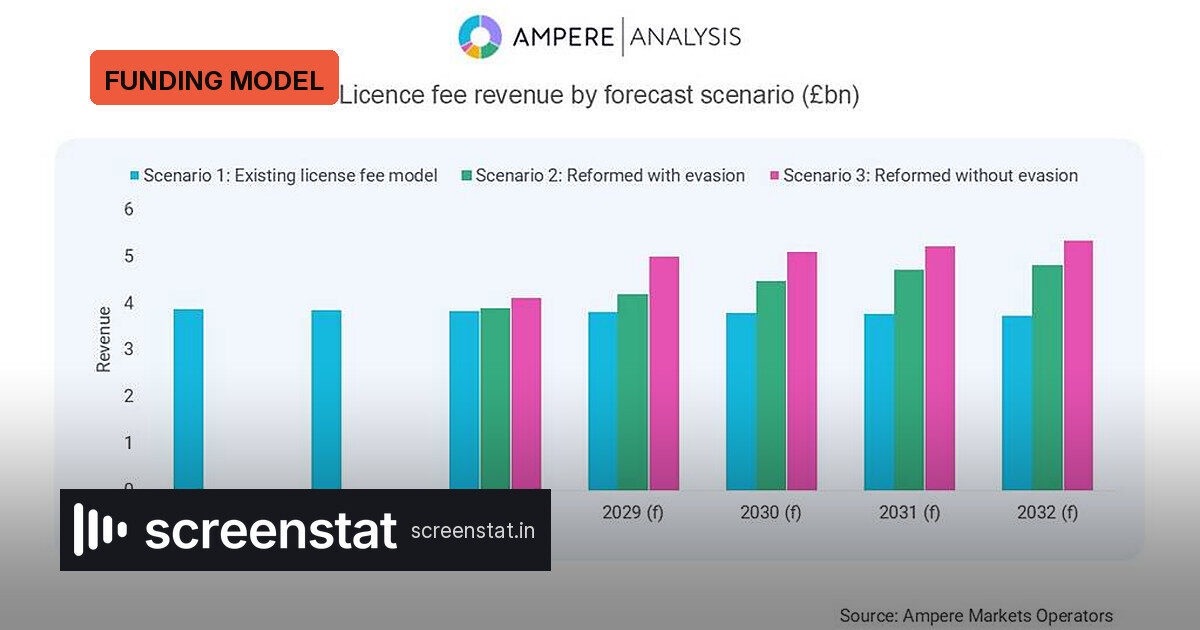
The bullish case rests on perfect enforcement. Under that assumption, a licence fee extended to streaming would generate an additional £1.6bn by 2032. But even if evasion stays near today’s levels, Ampere calculates the extension would still raise an extra £1bn.
- Perfect enforcement: £1.6bn more by 2032.
- Current evasion levels: £1bn more.
- Wider base with a price cut: licence could fall from £180 to £150 in 2028, a 17% reduction, while holding real-terms income.
That second option matters because it reframes the policy choice. Reform need not mean charging households more; it could mean charging a broader base less.
Why the BBC needs the money
Licence fee income has already fallen 24% in real terms between 2017 and 2025, according to BBC figures cited by Ampere. The current trajectory is not much better: Ampere forecasts revenue dipping from roughly £3.9bn in 2026 to £3.8bn by 2032, a small fall in cash terms but a larger one in real terms once inflation is priced in, with production costs hit particularly hard.
Ed Ludlow, research manager at Ampere, said extending the fee to streaming at the current rate could “future-proof the BBC for the times ahead.”
The strategic bet for the next charter
Ampere argues both extension scenarios would more than reverse the decline, giving the BBC a more stable base from which to invest in content through the next charter period. Senior analyst Sam Khoury said a widened fee would strengthen the BBC’s long-term financial position and its ability to compete with local and global rivals; alternatively, the government could ease cost-of-living pressure by cutting the price for a larger pool of payers and still improve the BBC’s outlook relative to the status quo.
For media planners and producers, the direction of that policy has a practical consequence: it determines whether the UK’s biggest content commissioner can defend its commissioning budgets against streamers, or keeps absorbing real-terms cuts.
What to watch next
The report’s timing is as important as the number. It drops in December, alongside the government’s Charter Review White Paper. That makes the £1.6bn not an academic figure but an input into a live negotiation about the BBC’s next charter period.
For ScreenStat readers, the story is a reminder that funding model debates shape the content market. A BBC with stable income can commission more high-end scripted, factual and children’s programming; a BBC squeezed in real terms becomes a smaller buyer, which ripples through UK studios, post-production and talent. The licence fee extension is effectively a market-structure question disguised as a tax question.