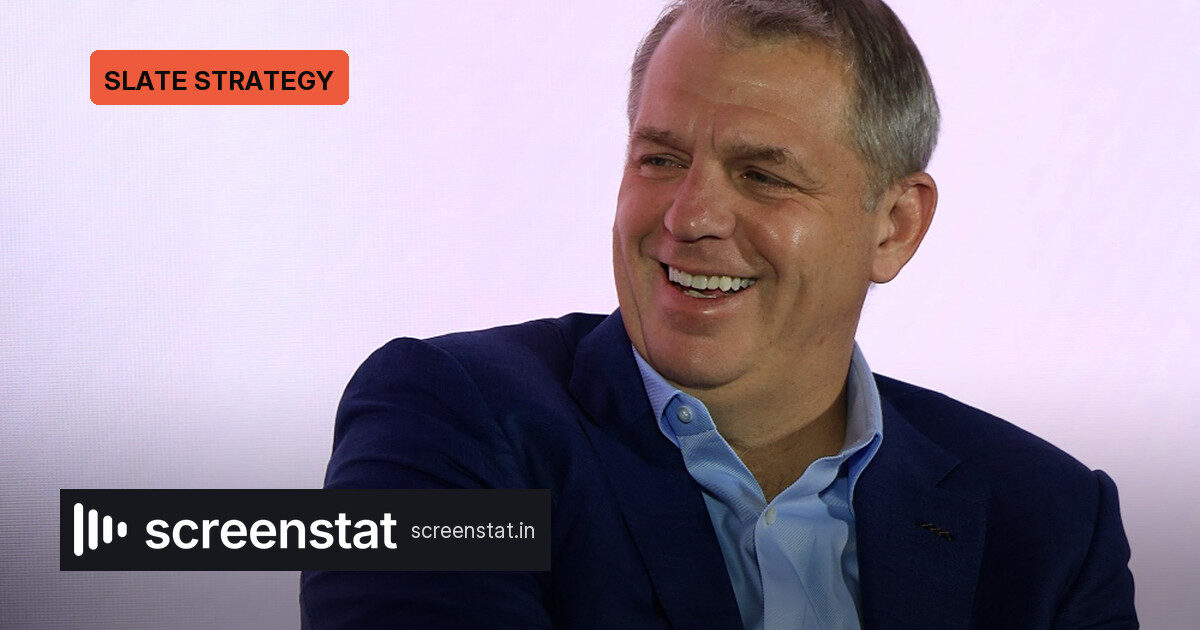
Todd Boehly used the closing fireside chat at the Qatar Film Committee’s Doha Industry Days to pull A24’s business model apart with a trader’s eye. His holding company Eldridge controls roughly $75B in assets, including a stake in A24, and he said the studio’s rise comes down to a simple discipline: entertainment is a risk-distribution business.
The trading-desk filter
“There’s very few entertainment people that understand math,” Boehly said. The math, in his telling, is about deciding how much risk to take and then how to feed and spread that risk across films and release windows.
Katz worked on a Guggenheim Partners trading floor from about 2008 to 2012, and Boehly said his strength was saying no a lot rather than taking big risks. He recalled a Stark Investments slate led by Wolfgang Petersen’s Poseidon, a $160M disaster movie. Katz flagged it immediately as a likely money-loser, and Poseidon went on to falter at the box office and become a cautionary tale in film financing.
A 15-film portfolio, not a one-off bet
Boehly provided $19M in seed money when Katz launched A24 in 2012. The company was last publicly valued at $3.5 billion in June 2024. Boehly argued that the gap comes from treating a slate like a portfolio.
He described the framework as roughly 15 films:
- Nine core films: budgets of $25-40M, targeting 1.35x returns, with about 0.8x recovered quickly and only 0.2x of risk capital still at stake.
- Three big swings: projects built to become multi-film properties, where expected returns shift to around 1.2x but enterprise value is higher.
- Three new-talent bets: films from emerging directors that demand time and attention more than heavy capital.
Why the math matters
The structure changes how A24 thinks about success. If a core film returns 0.8x fast, the real risk is 0.2x; a 1.35x outcome then works as a multiple on that smaller capital base. It is a structured-finance approach built on release windows, not just opening weekend.
Boehly said the early buys showed the same thinking. Spring Breakers, acquired for a couple million dollars, quickly returned about $10M. For him, that was a structured finance trade in a business that prefers to talk only about creative intuition.
The second insight is recurrence. Katz, Boehly said, wants repeat customers: directors and actors who come back, so each project becomes a recurring business relationship rather than a transaction. That is the difference between a slate of films and an enterprise.
For content teams, the lesson is to classify projects by expected return, recovery speed and upside before production begins, and to say no early to anything that does not fit the portfolio.