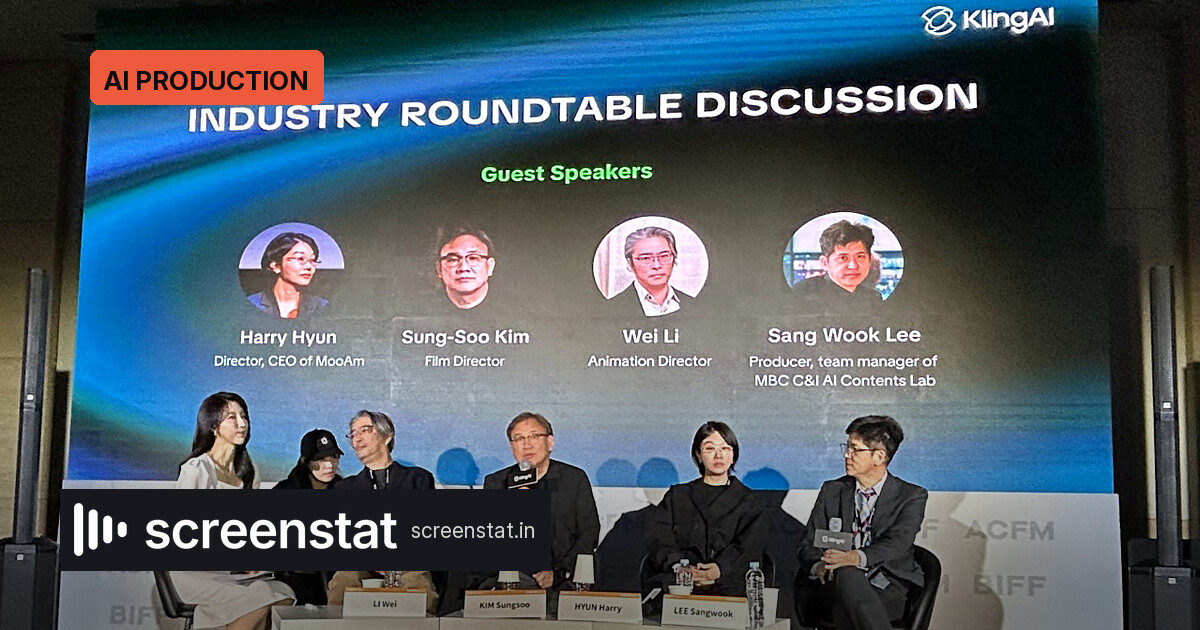
At Busan’s Asian Contents & Film Market, the conversation around Kling AI landed on a practical tension: the tools are now widely available, so the output is at risk of becoming visually interchangeable.
Korean director Kim Sung-soo presented a teaser for Worm Train, a short inspired by Franz Kafka’s Metamorphosis. He said AI has changed how he thinks about production, but not the core question of what makes a film cinematic. With similar tools accessible to everyone, some creators will make a masterpiece and others a mediocre film. Kim, who once expected AI to damage the industry, now argues that “technology does not replace creativity.”
Harry Hyun, director and CEO of MooAm Co, pushed the same point into craft specifics. AI production is not fundamentally different from traditional production, he argued; the difference is efficiency and simplicity. Without experienced filmmakers, results can drift toward a uniform look. The same lighting and framing choices repeating across projects are why AI images may impress early and then stop standing out. Hyun said teams need an art director for fine tuning and a director and cinematographer who know when to use a close shot, a wide shot or a particular frame. Working with experts is what avoids “cookie cutter deliverables.”
Chinese animation filmmaker Li Wei, making the animated feature Born of the Tide with Kling AI tools, pointed to a practical advantage: results are visible immediately, which makes it easier to get feedback from multiple crew members. That turns AI production into a faster feedback loop, but only if the crew actually uses it.
Lee Sang-wook, producer and team manager at MBC C&I’s AI Contents Lab, presented a teaser for Rendering Love, produced with Barunson E&A. The series combines traditionally shot live action with AI-generated characters to tell the story of a virtual K-pop group. Lee said all staff must understand the technology, and before a new model is adopted, team leaders need to analyse new features and share that understanding. If anyone lags behind while the technology changes, overall quality can fall.
Why this matters for media teams
For entertainment marketers and media planners, the panel is a warning about sameness at scale. AI can compress cost and time, but if every brief runs through the same defaults, brand-funded and commissioned content loses distinctiveness. The differentiator is not access to Kling; it is the human layer that decides framing, lighting and shot choice.
What production teams should lock before an AI project starts:
- Treat tool access as the baseline, not the creative advantage.
- Assign an art director, director or cinematographer to own the look.
- Build crew-wide feedback early, while outputs can be reviewed instantly.
- Brief team leads on model updates before the full crew adopts them.
- Start rights and infringement checks at the concept stage.
Standards are still open
Kim pushed back on rushing industry standards, at least in South Korea. Creators want room to experiment, he said, and the sector should see where AI filmmaking is heading first. But he added that rights infringement is something to be conscious of from the early stages. For now, the practical position is clear: no fixed rules, but early rights hygiene and real craft oversight.
The panel, titled New Cinematic Possibilities: Reimagining Filmmaking with Kling AI, ran as part of the InnoAsia track at ACFM, which continues until October 13. Kling AI recently released its 4.0 image generation model.
Source: Deadline