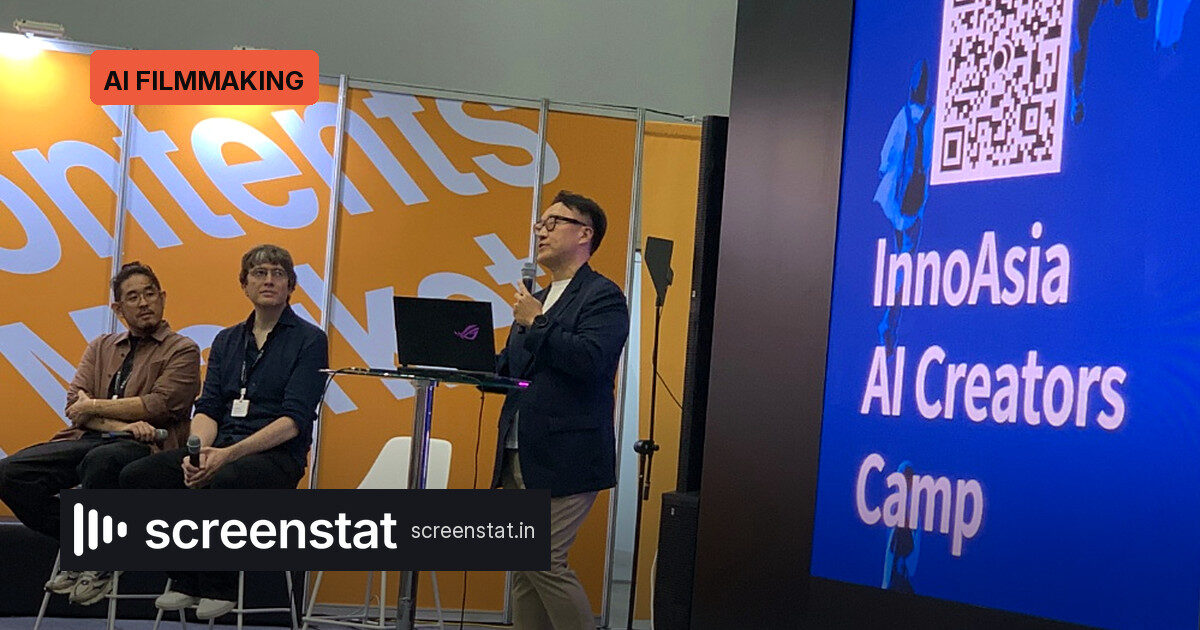
Small AI-native companies with automated pipelines can now own original intellectual property, while traditional studios hold their edge in established franchises, production infrastructure, talent and distribution, VFX veteran Hong Jae Cheol said Sunday at the InnoAsia AI Creators Camp in Busan.
Hong, a producer-director at Viscode whose career began at Industrial Light & Magic and includes work on “Iron Man,” “Transformers” and “Pirates of the Caribbean,” made the case that the conversation has shifted. “We are moving from using AI to generate individual images toward using AI as part of a complete production workflow,” he said.
Hybrid production, not wholesale replacement
Hong contrasted the old live-action and VFX process — 3D assets, animation, rendering and compositing — with an AI-assisted model. In his version, actors perform on a controlled set; AI generates environments and visual elements; VFX artists handle tracking, integration and finishing. The message: generated material still needs traditional VFX to be usable on screen.
He listed the current applications where AI is already doing practical work:
- Rotoscoping and cleanup
- Previs, character design and camera tests
- Environment creation
The creative shift
Mark Wachholz, chief creative director of Berlin-based Dreamkite Studios, put the change in creative terms. He described AI co-creation as an invitation to give up some control and allow for surprise: “exploring instead of controlling” and “finding instead of knowing.” New tools, he argued, demand new ways of thinking rather than old methods bolted onto new technology.
Director Ahn Jaehong of Climax Studio, who turned to AI filmmaking after arm injuries ended his work behind the camera, mapped the workflow from prompts and camera information through scene context, shot lists, storyboards, character and prop sheets, locations and keyframes. The point shared across speakers: AI can assist across many stages, but filmmakers still shape the story, visual design and final result.
What this means for screen business teams
For media planners, entertainment marketers and streaming operators, the Busan session points to a practical split: use AI as a pipeline stage, not a replacement. Automate the roto, cleanup and previs; keep human direction and VFX expertise on the sequence and the final frame. The discussion matters because AI-native studios can cheaply carry IP from concept through pre-production, while larger studios keep replenishing franchise value with established characters, marketing and distribution. That creates a two-speed market: one layer of low-cost, high-experiment IP generation and another of large-scale finishing and release infrastructure.
Hong summed it up: “AI is just a tool; film is a sequence.”
Source: Variety