
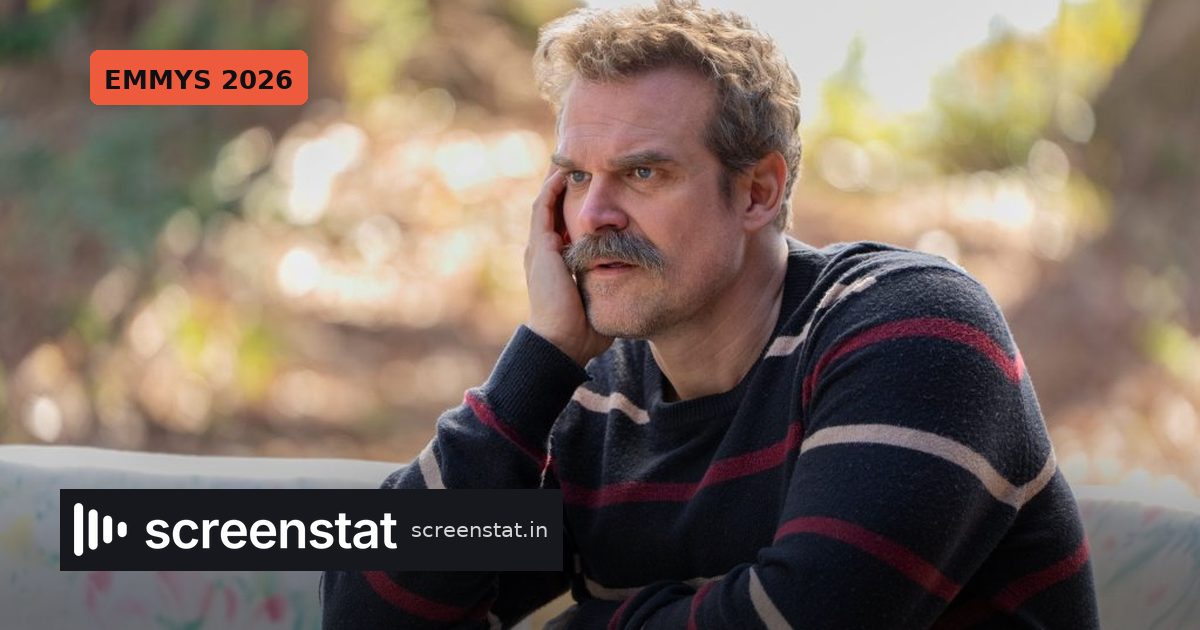
David Harbour has his first Emmy. The Stranger Things star won Outstanding Supporting Actor in a Limited or Anthology Series or Movie on Sunday for HBO’s dark comedy DTF St. Louis, converting a fourth career nomination into a first trophy.
The category was unusually stacked with talent from the same show. Harbour was up against his own co-stars Jason Bateman and Richard Jenkins, plus Richard Gadd for Half Man. Accepting the award, Harbour said he was “really moved” that voters had embraced the series, and joked that against his fellow nominees “it was not a fair fight.” He then thanked HBO for its “tons of notes,” drawing a laugh from the room.
Why one supporting-actor win matters more than it looks
DTF St. Louis arrived at the 78th Primetime Emmy Awards with 13 nominations. That is a serious tally for a limited series, and it puts the title in the small group of shows that a platform can build an entire prestige narrative around for a full year.
The show is a dark comedy about a love triangle between three adults working through middle-age malaise, which ends with one of them dead. It also competed this weekend in craft categories including costumes, sound mixing and cinematography.
For media buyers and streaming strategists, the number to watch is not the trophy count in isolation. It is what a multi-category sweep does to a title’s shelf life. Limited series have no next season to sell, so awards are the primary mechanism for extending discovery windows and giving the marketing team a reason to re-promote a finished show on the home screen.
The calendar quirk worth noting
This year the Supporting Actor and Supporting Actress winners in the limited category were announced during Emmys Night 2 – previously known as the second night of the Creative Arts Emmys – rather than on the main primetime telecast, which lands on September 14.
That split matters commercially:
- Less live reach. Wins handed out off the main telecast get a fraction of the broadcast audience, so the publicity lift depends almost entirely on next-day coverage and social clips.
- Two promotional spikes instead of one. A platform can market the early wins now, then market the primetime results again a week later.
- Momentum signalling. Craft and supporting wins are the traditional early read on where the top prize is heading.
Harbour can double his haul on September 14. He executive produced DTF St. Louis through his company Bravo Axolotl, so a win for Outstanding Limited Series would hand him a second Emmy as a producer.
What this says about the star-to-producer pipeline
Harbour’s path is now a familiar one for streaming-era talent. He was nominated twice for playing Jim Hopper in Stranger Things – a role built by one platform’s flagship franchise – and has converted that visibility into an ownership position on a prestige limited series at another.
For anyone tracking talent deals, that is the pattern to model. The value of a franchise lead is no longer just the next acting fee; it is the production entity that follows, and the ability to attract an HBO-scale commission. Producer credits change the economics of a career and, increasingly, the economics of how limited series get greenlit at all.
What to do with this
If you plan campaigns around awards windows, treat the September 7 and September 14 results as two separate media moments rather than one. Early supporting and craft wins are the cheapest signal you will get on which titles are about to receive a second wave of platform merchandising – which is exactly when a completed limited series becomes viewable again to audiences who missed it the first time.
Source: Deadline