
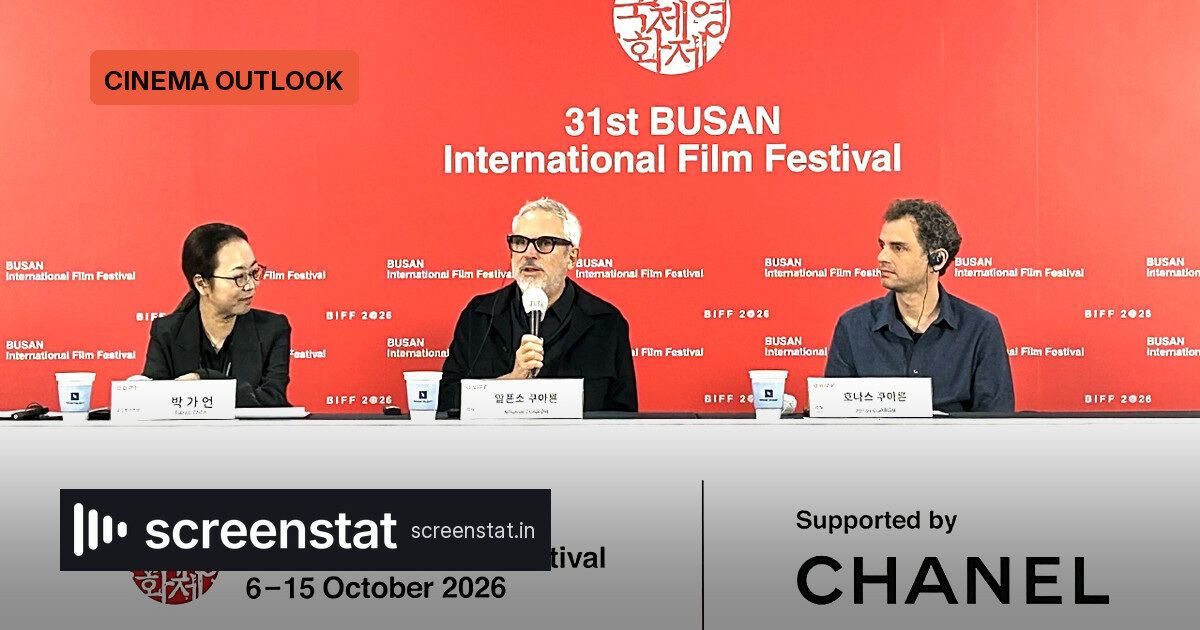
At Busan International Film Festival on Thursday, Alfonso Cuarón framed the next phase of cinema as additive rather than substitutive. The four-time Oscar winner said he believes theatres will keep existing, but the format will ‘coexist with more forms’ alongside newer ways of watching. He added that the shift leaves him pleased and also afraid.
BIFF is hosting a special IMAX screening of Gravity, which Cuarón co-wrote with his son Jonás, and the Asian premiere of Jonás Cuarón’s SXSW film Campeon Gabacho, the story of a Mexican immigrant in New York. That double billing made the festival a useful snapshot of the argument: premium theatrical still matters, but it is not the only stage.
A portfolio view of distribution
For ScreenStat readers, the practical read is that cinema is becoming a portfolio business. No single release route owns the audience, and the Cuaróns are betting on more than one lane.
- Exhibitors: IMAX and other premium formats still earn their place when a title is treated as an event.
- Streamers and studios: distribution is now theatre-plus, not theatre-versus.
- Creators: genre remains a direct route to communal viewing; Jonás Cuarón is writing a horror script for exactly that reason.
The Cuaróns are not forecasting a smooth transition. Alfonso Cuarón said he is learning from a new generation, including his son, even after trying to steer Jonás away from film. That personal pivot mirrors the industry’s own adjustment: the next set of formats will be shaped by creators who grew up across theatrical, streaming and social video.
Genre as the audience’s shared signal
Jonás Cuarón explained that he likes how genre connects with an audience. Pointing to the Gravity screening, he said viewers were ‘really stressed out’ for Dr. Ryan Stone, and horror offers a similar communal reaction to comedy. He also cited Korean films such as The Host and Parasite as models that carry social themes under genre and humour.
Alfonso Cuarón added a portfolio lesson for film businesses: far more of his projects fall apart than get made. Those failures, he argued, helped create later films that were better received. That is a useful R&D lens for studios and producers evaluating slates.
The signal for planning
The cue for media planners and entertainment marketers is to stop treating theatrical and streaming as an either/or. Programme for shared physical reactions, whether through horror, comedy or large-format spectacle, and treat abandoned projects as learning inventory rather than sunk cost.
Source: Deadline