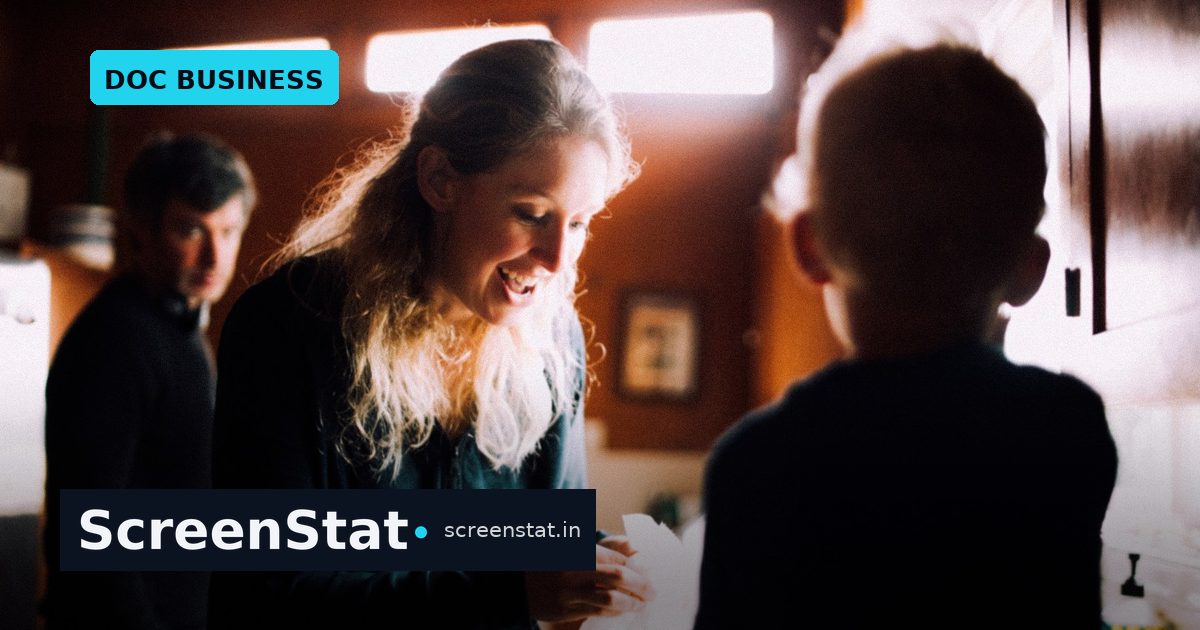
Telluride’s traditional secret screening slot went to one of the most commercially loaded documentary titles of the year: You Can See Everything, Nathan Fielder and Lance Oppenheim’s film about Theranos founder Elizabeth Holmes. The A24 documentary held its world premiere at the festival on Sunday night and is set for release in October.
According to The Hollywood Reporter, the screening drew the longest queues of the festival so far, and attendees were asked to hand in their phones on the way in. A teaser dropped the same night.
What the film is
A24’s logline sets the premise: with 34 days left before she reports to prison, Holmes invites a sceptical crew to film her, and what starts as a portrait of a convicted founder turns into a three-year project. In the teaser, Holmes says, per the source, “I’m always being real.”
Holmes was convicted of fraud in connection with Theranos, the blood-testing company she claimed could run a wide range of disease tests on tiny samples. She was named the youngest self-made female billionaire in the U.S. in 2015, was later found guilty of defrauding investors, and is serving a sentence of just over 11 years.
Why the secret-screening play matters
Festival secret screenings are not sentiment; they are a marketing instrument. For a documentary with a well-known subject, the mechanics are simple and repeatable:
- Manufactured scarcity. No advance title means no advance pans, no leaked reactions, and a queue that becomes the story.
- Phone lockup. Killing in-room video keeps the first images under studio control, so the teaser lands as the only visual asset in circulation.
- Single-day news cycle. Premiere, title reveal and teaser drop compressed into one night maximises search volume on a single date rather than spreading it thin.
- Release runway. An October date gives roughly a month-plus of festival-driven awareness before the film has to convert attention into ticket sales or platform sign-ups.
That last point is the one media buyers should note. Awareness generated at a festival decays fast. The narrow gap between a September premiere and an October release is a deliberate choice to spend the spike rather than store it.
The scam-doc category is now a business, not a genre
Fraud and founder-collapse stories have become one of the most reliable engines in non-fiction video: they arrive with a pre-built audience, free press coverage from business media, and search demand that already exists before a single frame is cut. Theranos alone has already generated a book, a podcast, a documentary and a scripted series. Repeat exploitation of the same IP is now normal, and the differentiator is access.
Access is exactly what this project is selling. A subject filmed in the weeks before prison, then followed over three years, is a materially different asset from an archive-and-talking-heads cut. It also explains the directorial pairing: Fielder’s work sits in the uncomfortable space between documentary and performance, which is thematically on the nose for a subject whose central legal question was what she knew and when.
What to watch next
Three numbers will tell the story. First, the release pattern in October: a theatrical window signals A24 is treating this as an awards and event title, a fast platform hand-off signals a subscriber-acquisition play. Second, teaser view counts and completion rates over the next fortnight, which are the cheapest available read on unaided demand. Third, whether the film clears the awards-season shortlist, because documentary campaigns live or die on that qualification.
For Indian planners, the read-across is straightforward: the local streaming slate is still under-indexed on premium, access-driven business documentaries, despite a domestic pipeline of corporate scandals with the same built-in audience economics.
Source: The Hollywood Reporter