
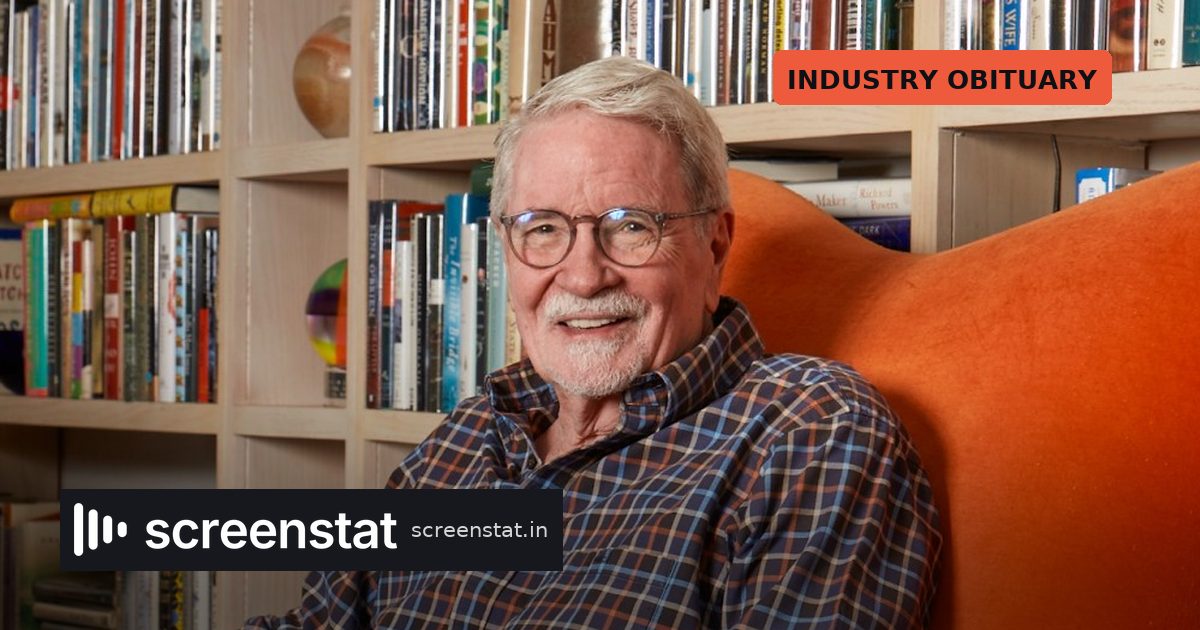
Bruce Davis, who ran the Academy of Motion Picture Arts and Sciences as its Executive Director from 1989 until his retirement in 2011, died on Sept. 5 in Los Angeles at the age of 83, Variety reported. He was 83.
A 22-year run at the centre of the film business
Davis arrived at the Academy after chairing the theater department at Juniata College in Pennsylvania, where he had also founded the film department. He had studied filmmaking at Columbia University, and was a film obsessive from childhood in Washington, D.C. At the Academy, he began by overseeing public programming before being named Executive Director in 1989.
That tenure covered the period in which the Oscars matured from an industry ceremony into a globally televised, sponsorship-heavy media property. But the two achievements the Academy itself points to are structural rather than televisual: Davis worked with the city of Beverly Hills and then-Academy president Robert Wise to secure rights to the 1928 building that became the Margaret Herrick Library, and oversaw the acquisition of a 1948 Hollywood television studio that became the Academy Film Archive.
Why archives matter to a streaming-first industry
It is easy to file library and archive work under heritage and move on. That would be a mistake for anyone whose job involves content valuation today. The economics of catalogue have changed sharply in the streaming era, and the assets that survive in usable condition are the ones that keep earning.
Consider what physical and rights infrastructure actually enables:
- Catalogue licensing: Restored, properly documented titles can be licensed and re-licensed to streamers, FAST channels and airlines. Undocumented ones sit idle.
- Restoration and re-release cycles: Anniversary theatrical runs and 4K remasters depend on surviving elements, not just goodwill.
- Provenance and clearance: Research collections settle who owns what, which is the gating item on almost every archive deal.
- Documentary and clip economies: Behind-the-scenes stills, scripts and production papers feed an entire secondary content market.
Institutions like the Herrick Library and the Academy Film Archive are the quiet plumbing under all of that. Executives who built them rarely feature in trade headlines, because preservation spending shows up as cost in one decade and revenue in the next.
The Indian read-across
India’s film industry has spent the last few years learning this lesson expensively. A large share of pre-1990s output has degraded or vanished, and restoration efforts have often depended on individual archivists and foundations rather than an endowed, permanent institution with a building, a mandate and a budget line. As Indian streamers keep hunting for differentiated library content at a time when original commissioning budgets are under pressure, the value of a well-kept back catalogue only rises. What Davis helped assemble in Los Angeles over two decades is a working model of what that institutional layer looks like when it is funded properly.
The writer behind the administrator
After retiring, Davis wrote The Academy and the Award, a history of how the Oscars came to be. Within the organisation he was remembered for his wit and his writing, and for a Friday Lunch tradition that pulled staff from different departments around one table \u2014 a small, unglamorous management habit that any organisation trying to break its own silos might note.
He is survived by his wife Joann and four daughters: Brangien Davis, Alexandra Davis, Archer Davis and Roxanne Davis. Donations may be made to Juniata College.
Source: Variety