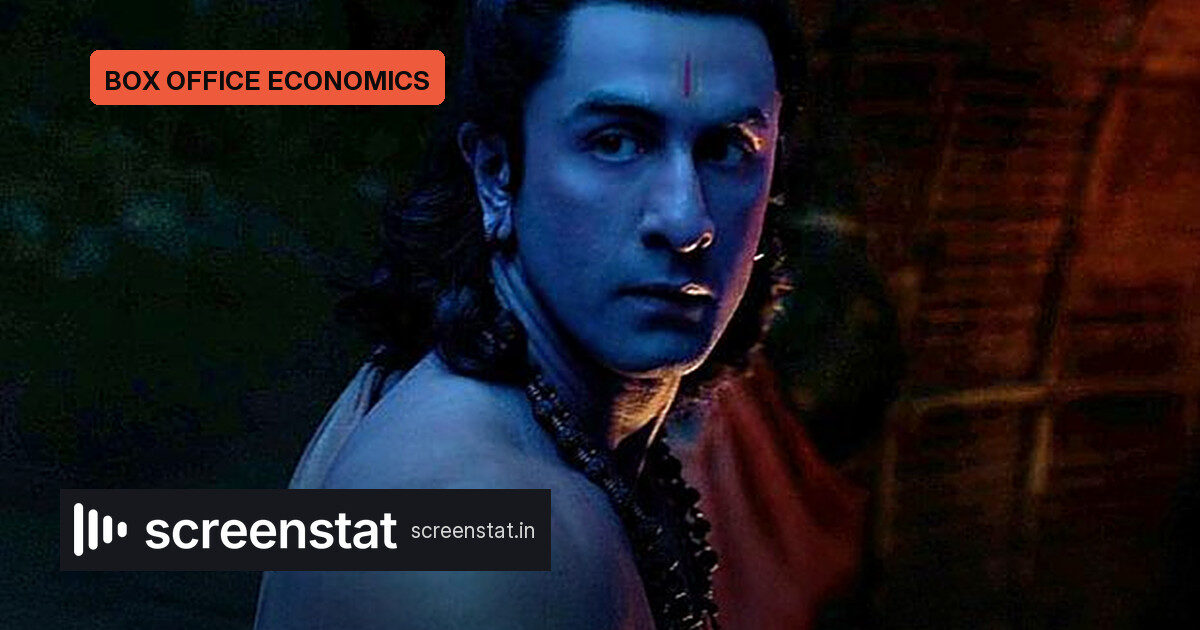
Ramayana – Part I has turned format mix into a box office headline. The Hindi version’s detailed split until November 23, 3:30 pm shows standard 3D collected Rs 379.13 crore nett, against Rs 244.61 crore for standard 2D—a gap of Rs 134.52 crore.
More tickets, not just pricier tickets
The usual assumption is that a premium format earns more because each seat costs more. Ramayana breaks that pattern in the Hindi market. Standard 3D sold around 1.06 crore tickets, while standard 2D sold about 86 lakh. That is roughly 19.65 lakh more admissions for 3D.
The average nett realisation per ticket was Rs 359 for Hindi standard 3D and Rs 284 for Hindi standard 2D. So 3D delivered about 26.2% more revenue per admission, or roughly Rs 74 extra per ticket.
This is the story in two layers:
- 3D won on volume: it sold more tickets, not just more expensive ones.
- 3D won on yield: each admission carried a higher average price.
Premium formats stretch the gap further
The advantage grows when specialised screens are included. Hindi IMAX 3D generated Rs 48.82 crore nett from 4.79 lakh tickets, averaging about Rs 1,020 per admission. Hindi 4DX 3D averaged around Rs 781 per ticket, and Hindi ScreenX 3D around Rs 625.
Those averages are far above the standard 2D baseline. They matter because they show audiences are actively choosing enhanced presentations rather than simply paying a small surcharge on a regular show.
What it means for the business
Across all formats, the Hindi version had collected Rs 689.71 crore nett by the same cutoff. Standard 3D alone accounts for Rs 379.13 crore, or about 55%. Include IMAX, 4DX, ScreenX and other premium 3D formats, and the 3D contribution is even larger.
The caveat is important: the data does not prove every 3D customer would have bought a 2D ticket otherwise. And some of the premium may come from screen location, seating category or showtime, not just the technology. But for a large-scale visual spectacle, the commercial signal is clear: 3D can be a primary revenue engine, not an add-on.
For exhibitors and distributors
For a film positioned as spectacle, format mix should be part of release planning, not a last-minute upcharge. The Hindi 3D result suggests three moves: protect enough 3D shows in prime hours, price the premium relative to a defined 2D baseline, and track admissions separately from revenue so volume effects are not hidden inside average ticket price.
Media planners buying cinema or brand integrations around such titles should treat premium-format buyers as a distinct audience segment. They are younger, more willing to pay, and more likely to choose an event-style outing—useful for campaign placement and for measuring the value of a film property.
Ramayana’s Hindi split is not just a win for the film. It is a case study in how presentation format changes the economics of a release after the content decision is made.