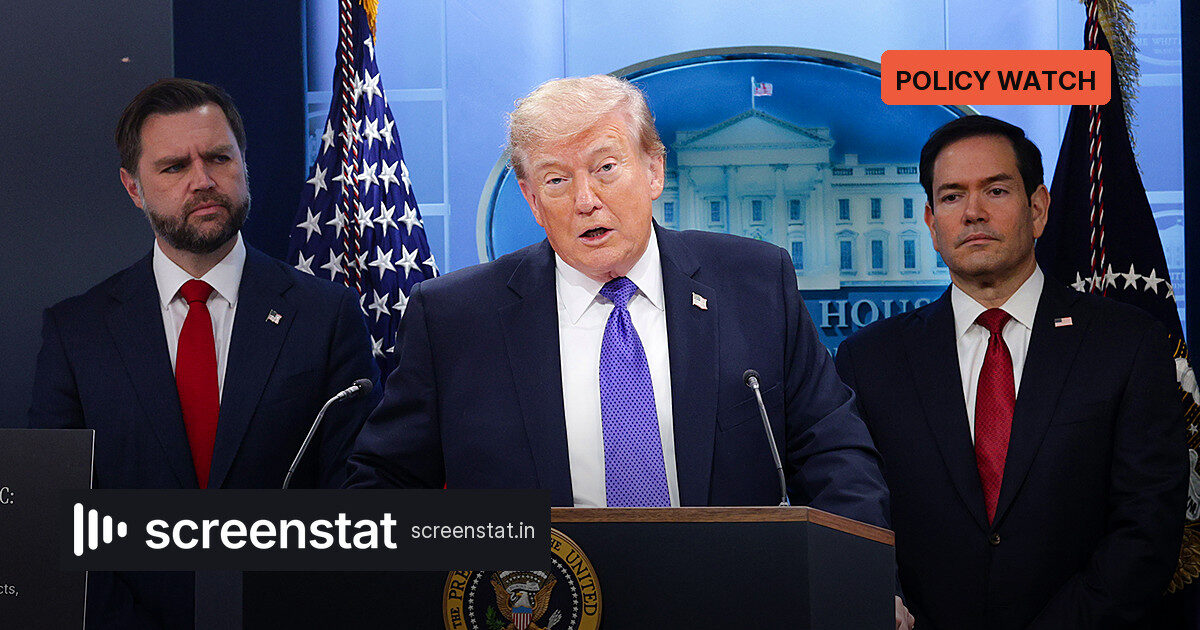
President Donald Trump said Friday that the federal bill to create a tax credit for film and TV production could be broadened to include support for movie theaters. Speaking at the White House, he said negotiators are actively discussing the addition, though no final decision has been made.
The production credit he has previously backed would offer producers a 20% to 30% credit on domestic labor costs. A theater component would be a separate expansion: the SCREEN Act, introduced in July, proposes a 30% credit for theater renovation, with per-site awards ranging from $250,000 to $500,000.
A theater clause enters the negotiation
Trump’s comments mark the first time he has publicly tied theatrical exhibition to the production-incentive push. “We’re working on a bill for entertainment, which is motion picture, television — we’re thinking about adding certain other elements, like for instance theaters,” he said.
He framed it as unfinished negotiating territory: “We don’t know if we’re going to do that yet. But we’re actively in negotiations on that, and that’s going to be very bipartisan.”
Cinema United, the trade association for theater owners, has been pressing for renovation support. Its president and CEO, Michael O’Leary, has argued that a credit would have a “tangible and positive cultural and economic impact” in local communities.
Why the window is short
The production bill’s supporters want it passed in the lame-duck session that ends in mid-December, before the new Congress arrives. Hollywood union leaders met with lawmakers this week to make that case, arguing that White House attention may not last into the next session.
Trump said the measure has “unbelievable support” and predicted it will pass. He also said the entertainment industry would be “thriving” if the bill becomes law, arguing that production has migrated to Canada, the U.K., and Australia.
He added that state-level programs matter but are not sufficient: “New Jersey did a good job. A couple of them have done good, but it doesn’t matter if they don’t have the federal government.”
Trump also appeared eager to frame the effort as bipartisan, invoking California Democratic Sen. Adam Schiff’s response: “Adam Schiff said, ‘Wow, we love that bill.’”
What this means for budgets
For media planners, producers, and exhibition finance teams, the news is a signal to keep two numbers in the model:
- 20%-30% on qualified domestic labor if the production credit passes.
- 30% on renovation costs, capped at $250,000-$500,000 per site, if a theater provision is attached.
If both elements move together, the bill would touch production and exhibition at the same time—lowering labor and physical production costs while giving theater owners an incentive to upgrade screens, seating, and projection.
The caution is timing. The language remains in negotiation, and theater support is not guaranteed. Teams should treat it as a live but uncommitted item through mid-December, not a done deal.