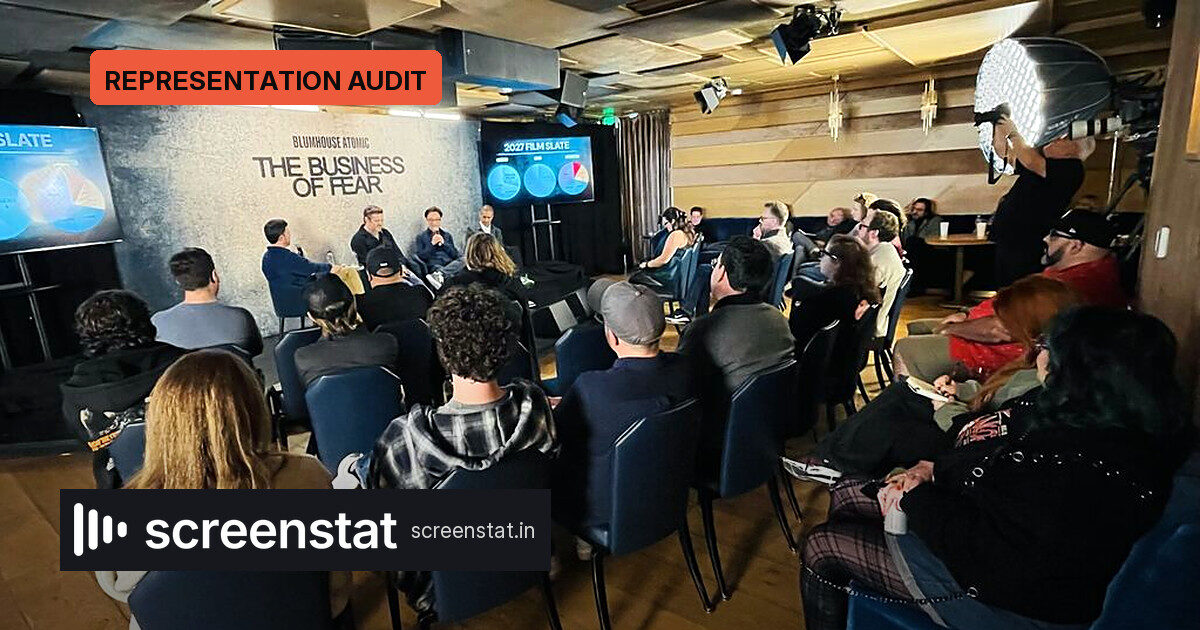
At its “Business of Fear” press conference, Blumhouse Atomic put a number on nearly everything: a claimed majority share of worldwide horror box office, 10 films scheduled for 2027, six originals, four franchise entries, seven “emerging voices,” including three first-time feature filmmakers. One number was not on the slides. When asked how many of those 10 theatrical releases were directed by women, the answer was zero.
“So we are working with a lot of women,” Blumhouse founder and CEO Jason Blum said. “They didn’t fall in next year’s slate.” He called director diversity “very, very important” so that filmmakers “reflect our audience and look like our audience.”
The gap between theatrical and streaming
The company says women directed 25 percent of its 2026 film slate. But the titles cited, including Yoko Okumura’s “The Last Kiss” and Kate Dolan’s “SOULM8TE,” premiered at home. The distinction matters. Across 27 features that played in at least 600 U.S. theaters from 2021 through 2025, women helmed only two, both by Emma Tammi. That is roughly 7 percent. Over the same period, 22 straight-to-streaming or digital debuts included nine directed or co-directed by women — about 41 percent.
ROI shows the work, not the next job
Blumhouse Atomic calculates returns simply: worldwide ticket sales divided by production budget. “Five Nights at Freddy’s” earned nearly $300 million worldwide on a reported $20 million budget; the 2025 sequel added $240 million against $51 million. Together, the two Tammi-directed films grossed roughly 7.6 times their combined costs. Strong economics, but the pipeline still stalls before the next theatrical slate.
Blumhouse Atomic TV president Melissa Aouate said the company takes the contraction of opportunities for women seriously. “The industry still has a long way to go, and so do we,” she said.
Why this matters for media and marketing teams
For buyers and planners, a theatrical slot is not just a window; it is top-of-funnel visibility, marketing spend, franchise potential and career acceleration. A slate that is diverse in streaming but has zero women in 10 theatrical slots sends a different signal to audiences, talent and brand partners. Industry-wide, women accounted for 13 percent of directors on the 250 highest-grossing domestic films last year, down from 16 percent in 2024, according to the Celluloid Ceiling report.
- Audit representation by release window, not by total project count.
- Track whether high-ROI filmmakers are automatically moving to larger theatrical budgets.
- Ask partners for theatrical-specific data before including them in diversity benchmarks.
Blumhouse Atomic has credited social-born creators such as Heidi Wong, whose TikTok horror storytelling led to a short-film development deal announced at New York Comic Con. Whether that path leads to a theatrical feature remains an open question. Eight years after Blum apologized for saying fewer women were inclined to direct horror, the company’s most visible slates still do not show parity. The horror business knows what scares audiences. The question is whether it will treat its own representation gap as a threat worth fixing.