Family offices may be the least visible force in entertainment, but they now control as much as $5 trillion in assets across more than 8,000 firms, a population growing nearly 5% a year. That is the capital behind the largest media transaction in 25 years: the formation of Skydance after its $111 billion close of Warner Bros. Discovery on Oct. 6.
The Skydance playbook
David Ellison’s run began with the $8 billion acquisition of Paramount and CBS, then extended to Warner Bros., HBO, CNN and Discovery. The backing did not come from a private equity fund. It came from Lawrence Investments, the Ellison family office, with an estimated $160 billion under management.
The structure is striking. The enlarged Skydance carries $80 billion in debt. If it misses its three-year debt and cost-reduction targets, Larry Ellison is personally on the hook for up to $40 billion in payments to lenders. The Oracle co-founder, recently a major shareholder in the US spinoff of TikTok, is effectively underwriting his son’s Hollywood ambition.
How family offices differ from private equity
Family offices are private holding companies the ultra-wealthy use to manage their money. They typically have no outside shareholders and little disclosure. Their incentives are different from traditional private equity:
- They hold for the long term, without a fixed seven-to-ten-year sale or IPO clock.
- They invest in sectors and assets they know, and can bring operating expertise.
- They can pursue trophy assets — studios, sports teams, music catalogues — that serve legacy as much as return.
- They usually disclose results only to insiders.
Among the heavyweights, Walton Enterprises manages about $225 billion, Elon Musk’s Excession around $200 billion, Bill Gates’ Cascade Investment about $170 billion, and Jeff Bezos’ Bezos Expeditions roughly $107 billion. The top 50 family offices hold an estimated $2.4 trillion; the top 10 account for $1.5 trillion.
The softer power of mission capital
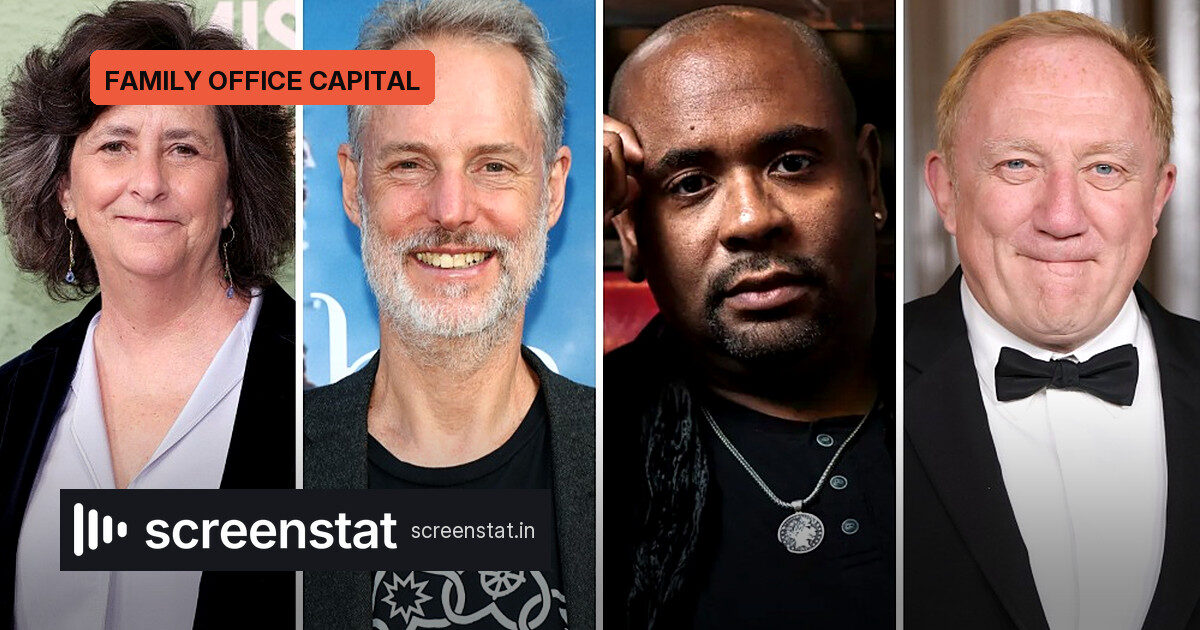
Much of the day-to-day impact comes from smaller family offices chasing influence. Steve Sarowitz’s 4S Bay Partners teamed with Justin Baldoni to launch Wayfarer Studios, the production company behind It Ends With Us. David Steward II has backed comic-book imprints and the Lion Forge Entertainment animation studio, and his family held a stake in the NHL’s St. Louis Blues from 2012 until 2024.
“We’re a lot more patient with outcomes because we have a higher vision,” Steward said. “We’re not only investing to get a return; we’re investing for change.”
What it means for the industry
For media planners and entertainment marketers, the owner’s identity now shapes strategy. A family office may hold a studio through a downturn that would force a fund to exit; it may also push a mission, a legacy or a favourite franchise over pure optimisation. CAA says it started seeing family offices in media, music catalogues and sports franchises about two to three years ago, and built services around them.
The risk is concentration. A single family’s balance sheet can move the market — and a single family’s debt problem can ripple through a slate of networks and studios.
Source: Variety