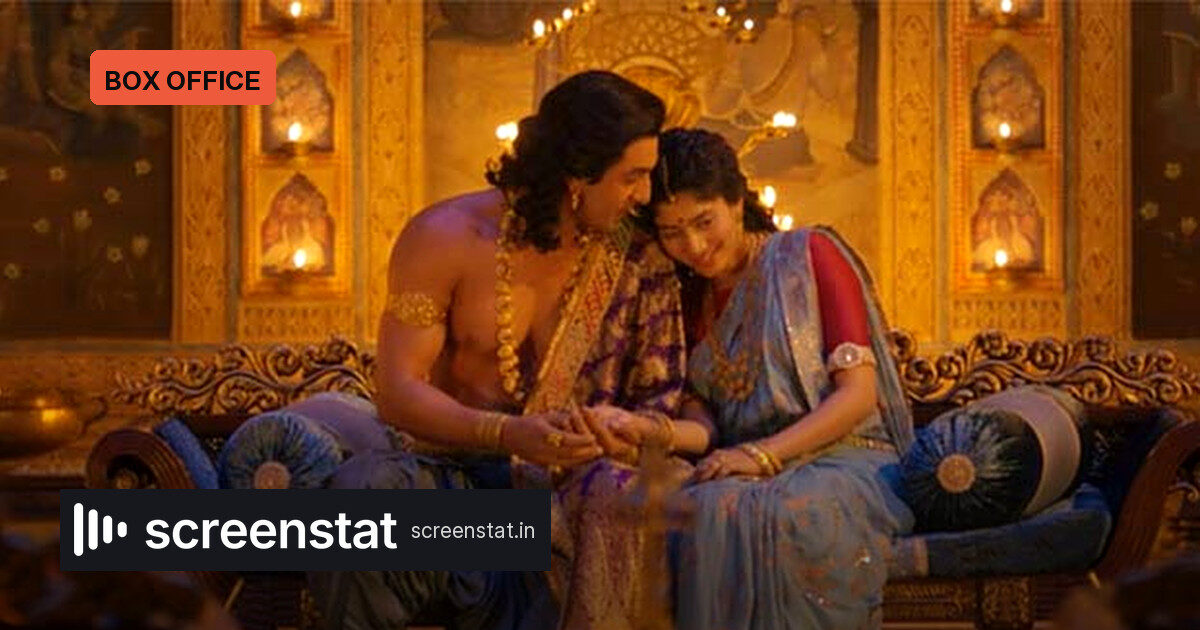
Ramayana – Part I, directed by Nitesh Tiwari and starring Ranbir Kapoor and Yash, has collected Rs 423.46 crore nett in its first six days at the Indian box office. The real story is how that money splits by language: the Hindi version accounts for Rs 326.07 crore, roughly 77% of the domestic total.
Hindi’s post-Diwali surge
The Hindi version’s path to Rs 326.07 crore was not flat. It collected Rs 35.41 crore on Sunday, November 8, before jumping to Rs 85.20 crore on Monday—a rise of about 140.61%. Tuesday delivered another Rs 74.05 crore. In two days, the Hindi version added Rs 159.25 crore, close to half its six-day total.
That pattern matters. A jump of this size after the Diwali weekend suggests the film is finding a weekday audience beyond the festive rush. If the hold continues, Hindi’s contribution share could remain the central driver of lifetime projections.
Southern languages are not one block
The six-day language-wise break-up shows a different hierarchy:
- Hindi: Rs 326.07 crore (about 77%)
- Kannada: Rs 38.05 crore
- Telugu: Rs 31.92 crore
- Tamil: Rs 15.54 crore (3.67%)
- Malayalam: Rs 11.88 crore (2.81%)
Kannada’s lead over Telugu is Rs 6.13 crore. Yash’s popularity in Karnataka gives the Kannada version an edge that is not automatic for every Hindi-led epic. Telugu remains the third-largest contributor, but it is behind Kannada despite being a larger theatrical market for many films.
Together, the four South Indian versions—Kannada, Telugu, Tamil and Malayalam—have collected Rs 97.39 crore, about 23% of the total. That is not a minor add-on.
What media teams should read from the numbers
For entertainment marketers and distribution planners, the six-day split is a practical planning tool. Hindi gives a pan-India release its scale; southern versions bring nearly a quarter of the business in this case. The language-wise data argues for treating each market separately, not bundling “South” into one line item.
Kannada beating Telugu is a reminder that actor-level demand can change a language mix. When a star such as Yash is central to a film, Karnataka can over-perform relative to the usual pan-India template. The next watchpoint is the Hindi version’s weekday hold after the Tuesday figure of Rs 74.05 crore: if the film holds above that level, its lifetime total gets a stronger base.
For a six-day-old film, the language split also tells a story about reach. Hindi is the volume play, but the southern languages together bought the film close to an extra Rs 100 crore. That balance is what a national blockbuster increasingly looks like: one dominant language and a portfolio of smaller, meaningful markets that can be scaled up when talent and distribution align.
Source: bollywoodHungama.com