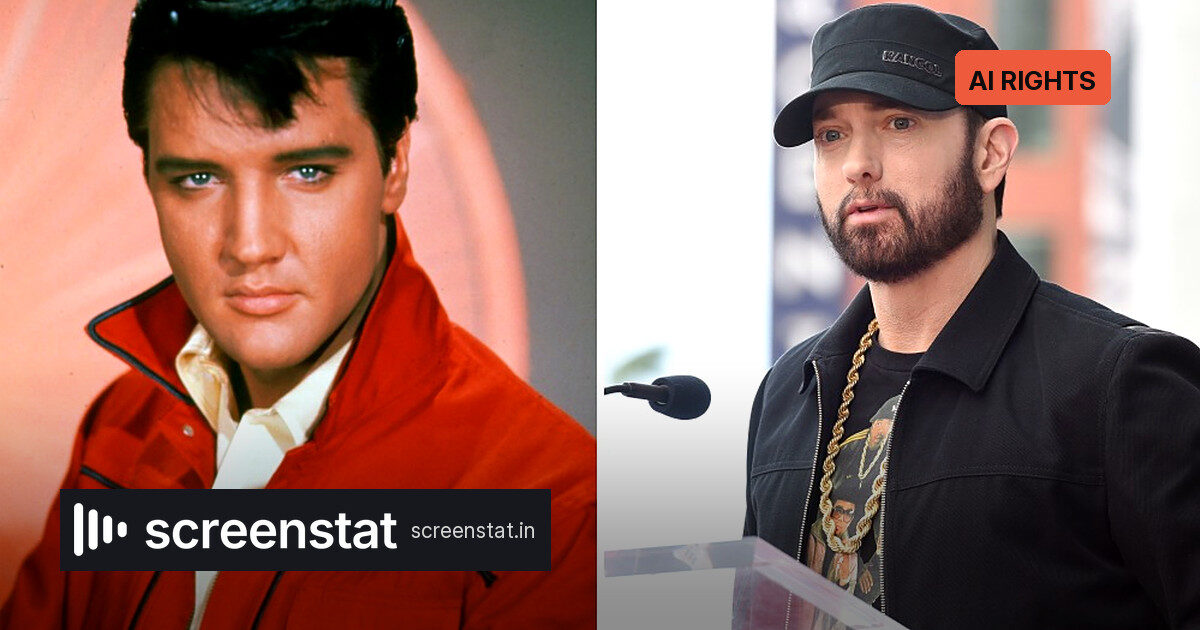
Elvis Presley’s rights holders and Eminem’s music publisher have opened a new front in the AI copyright fight, filing separate federal lawsuits against AI music generator Suno.
Two cases, one core claim
In California, a group including Authentic Brands Group and Raleigh Music Publishing claims Suno lets users summon Presley-style vocals without a license, and points to Tennessee’s ELVIS Act, the 2024 law barring AI voice clones. Eight Mile Style, which controls hundreds of Eminem recordings including “Lose Yourself” and “Without Me,” says Suno enables lyric and song outputs that mirror the rapper’s catalogue. Eminem is not a party.
The same legal team represents both sets of plaintiffs. In the Presley filing they wrote: “The next Elvis won’t pick up a guitar.” Suno says it blocks artist-name prompts and screens uploaded audio and lyrics, and prohibits unauthorised use of an artist’s work.
Why this matters for screen and audio teams
This is no longer just a music business story. The ELVIS Act turns a performer’s voice and likeness into a distinct IP asset, the same asset class that film, TV and advertising teams now use in AI dubbing, synthetic voiceover and avatar-driven campaigns. If prompting a style or tone becomes actionable, a vendor’s guardrails will not be enough for clearance.
The legal pile-up shows the pressure points:
- The Jason Isbell-led class action alleges users bypassed artist-name blocks by using real names or inserting spaces.
- Universal Music and Sony Music have separately sued over Suno’s label-backed “v6” model.
- Authentic Brands Group has also sued Anthropic over 274 Presley songs, seeking $48.6 million.
- Eight Mile Style sued Meta for roughly $110 million over 243 recordings held in its libraries.
The money signal
The courtroom noise hasn’t dented Suno’s valuation. It raised $400 million in June at a $5.4 billion valuation, with Warner Music Group’s earlier settlement and deals with BMG and Believe helping power v6. That gap between legal risk and market value is the real story for dealmakers: investors are betting that AI music platforms can license their way through, while rights holders are trying to make the law say the license is mandatory.
For media planners and marketers, the practical takeaway is to treat voice and likeness as a clearance item in every generative AI vendor contract, not a policy footnote. If Suno loses, AI audio and video workflows will need the same chain-of-title discipline as a sync track or an actor’s image.
Source: Variety