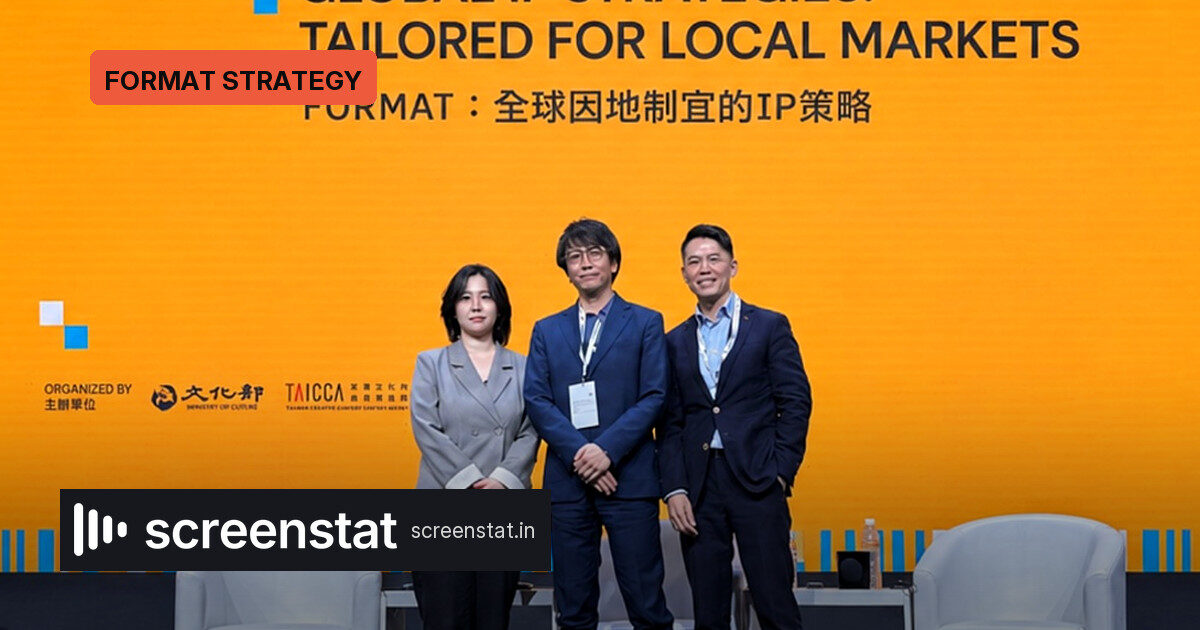
At Taiwan Creative Content Fest in Taipei, two format executives laid out a simple rule for global TV: keep the core idea, but change whatever local rules or local tastes demand. The clearest example came from NBCUniversal Formats’ Linfield Ng, VP of format sales and production for Asia.
The same show, a different briefcase
In the original Suits pilot, the briefcase that opens during a job interview is full of marijuana. In the Japanese remake, Ng said, that briefcase holds money, because drugs cannot be shown on Japanese TV. “That did not change the DNA of the show,” he said.
Localisation extends beyond props. SNL Korea dropped the musical segment because Korea already has a crowded market of music and countdown shows, and producers replaced politically pointed cold opens with topical material at sensitive moments. On Suits, every legal case is rewritten for the local audience, while the central story of a man without a law degree remains intact.
What travels, what doesn’t
TBS Television’s Fukaya Shunsuke pointed to Sasuke, known internationally as Ninja Warrior, as a format with a truly universal theme that fits in one line. TBS keeps a brand guide separate from the production bible, defining the show as an Olympics for unknown athletes. That guide is the benchmark against which local changes are judged.
Host-driven talk shows, by contrast, rarely work as formats because the banter between particular hosts cannot be reproduced abroad. What TBS licenses is the framework, rules and game, not the personalities.
The numbers behind the format trade
NBCUniversal Formats has sold more than 40 format brands across Asia. In 2025 alone, the company delivered 39 seasons across 17 territories. It has produced more than 25 versions of Top Chef, while TBS’s Ninja Warrior has local versions in 25 countries.
Entertainment and game shows account for about 59% of formats that sell well globally, but only about 40% in Asia, according to a 2026 K7 report Ng cited. Game shows do not work in Korea, so his team never pitches them there. Mongolia, Ng said, buys only what suits its market rather than the biggest U.S. or Asian hits.
- Clear structure
- Scalability across budgets
- A distinct selling point
- Budget- and sponsor-friendly design
Those are the qualities Ng looks for when acquiring third-party formats, because in Asia sponsors usually come first, unlike the U.S. where networks often fund the full cost.
The playbook for creators
Ng’s advice to Asian creators: research first, know what sets your show apart, and grab buyers quickly. “You’ve got to grab them within the first one to two minutes,” he said. TBS has been testing co-developed pilots in late-night slots because an aired show on a terrestrial network sells better than a paper pitch. The broadcaster’s Action! No Reaction is now under option in more than 10 European territories.
The wider lesson is a familiar one. “You just have to know your market, and you just have to basically think globally and act locally,” Ng said.
Source: Variety