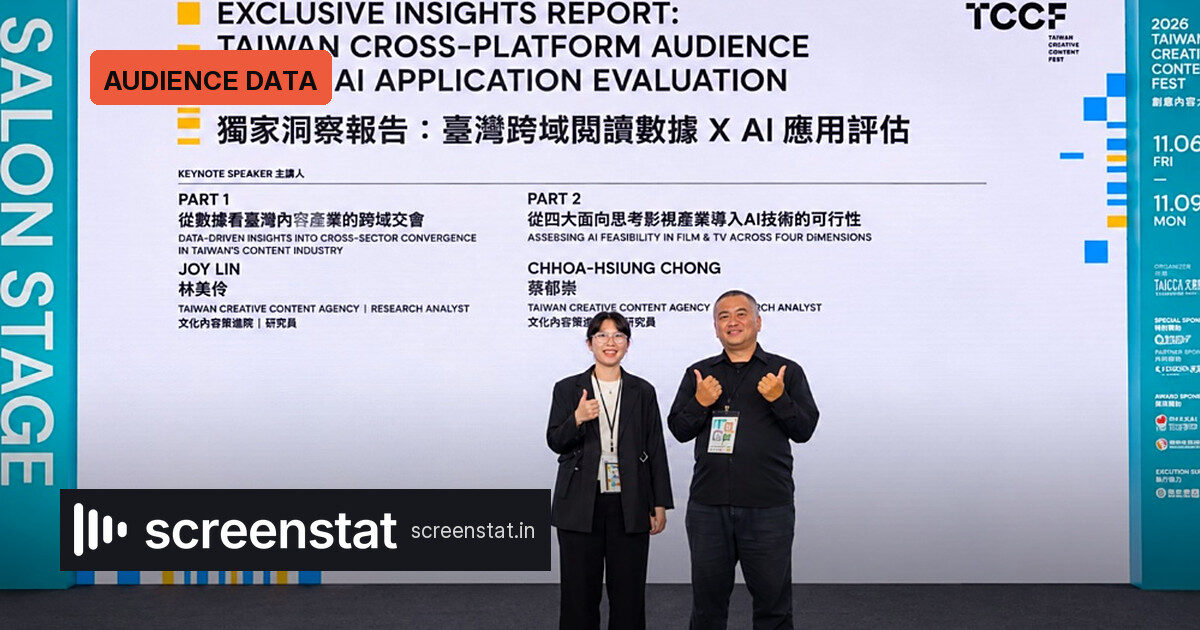
Taiwan’s content agency brought a number-heavy case to the Taiwan Creative Content Fest in Taipei on Friday: audience attention is already moving across formats, which makes cross-platform IP a planning problem as much as a creative one. TAICCA presented two research sessions, one on cross-platform consumption and genre demand, another on AI’s production economics and legal exposure.
Where Taiwanese audiences actually spend attention
The annual cultural consumption survey, built from roughly 2,000 valid responses, found 96% of respondents watched audiovisual content in 2025. Reading and gaming sat well behind but still large: 75% read published works and 75% played video games. The overlap between audiovisual and music was especially strong at 90%.
A separate 2026 cross-platform genre study surveyed 2,018 people aged 15 to 69. Of the 1,242 respondents who had watched Taiwanese productions in the previous year, 40% had also watched Taiwanese screen adaptations. That is a meaningful conversion signal for media planners: local viewers are not just sampling original series and films, they are following those stories into adapted formats.
Genre perception split along local and imported lines. Taiwanese productions were associated with everyday life, family relationships and romance; foreign titles drew strength in action, fantasy and suspense. Romance stood out as the bridge genre, linking school-life stories, comics, popular music and mobile games. Among Taiwanese romantic drama viewers, 84% also watched foreign series, 63% watched foreign films and 58% watched foreign animation.
- 96% watched audiovisual content in 2025.
- 90% engaged with both audiovisual and music.
- 40% of Taiwanese content viewers watched Taiwanese adaptations.
- 84% of local romance-drama viewers also watched foreign series.
What the numbers mean for IP planners
The data reframes cross-platform as an audience behavior rather than a corporate buzzword. Media planners can treat romance and school-life IP as low-friction entry points because demand already exists across comics, pop music and mobile games. The 40% adaptation figure is a ready-made baseline for evaluating whether a Taiwanese original has extension value. The local-versus-imported genre gap also suggests a portfolio question: local productions can own everyday and relationship stories, while action and fantasy remain categories where imported titles have the upper hand.
AI’s promise gets a cost and trust check
TAICCA’s second session moved from demand to production. Industry estimates, not Taiwan-specific numbers, placed AI use in post-production and visual effects at 70% to 85%, ahead of 60% to 75% in pre-production and only 15% to 25% on set. Netflix’s Argentine sci-fi series “The Eternaut” and CJ ENM’s AI-assisted productions were cited as examples of potential savings in production and VFX workflows.
But the risks were just as prominent. Technical problems remain around visual consistency, camera control, narrative continuity and fitting AI into established pipelines. On the legal side, the presentation cited 489 AI-related litigation cases through August 2026, of which 153 involved cultural and creative industries. Hollywood union protections negotiated by SAG-AFTRA, the WGA, DGA and IATSE now cover digital replicas, consent, compensation and creative control.
Consumer resistance adds a demand-side constraint. In a November 2025 Luminate survey, 51% of U.S. respondents rejected fully synthetic virtual performers. A Japanese survey in September 2026 found 44.7% would be less willing to buy content once they knew it was AI-generated, while a South Korean survey in January 2026 found 81.6% supported advance disclosure and 80.3% favored mandatory labeling.
Attendees pressed on whether reported savings fully account for the upfront cost of new workflows, experimentation and revisions, and on the lack of Taiwan-specific legal cases. That is the practical gap: AI can cut a late-stage VFX bill and still raise legal, disclosure and audience-trust costs earlier in the chain.
What to watch next
For platform and studio teams, the immediate moves are measurement-led. Track adaptation overlap before greenlighting, model AI costs with trial-and-error included, and treat AI disclosure as a market-access requirement rather than a compliance afterthought. The Taiwan data gives a clean audience map; the AI session shows why the economics are not yet settled.
Source: Variety