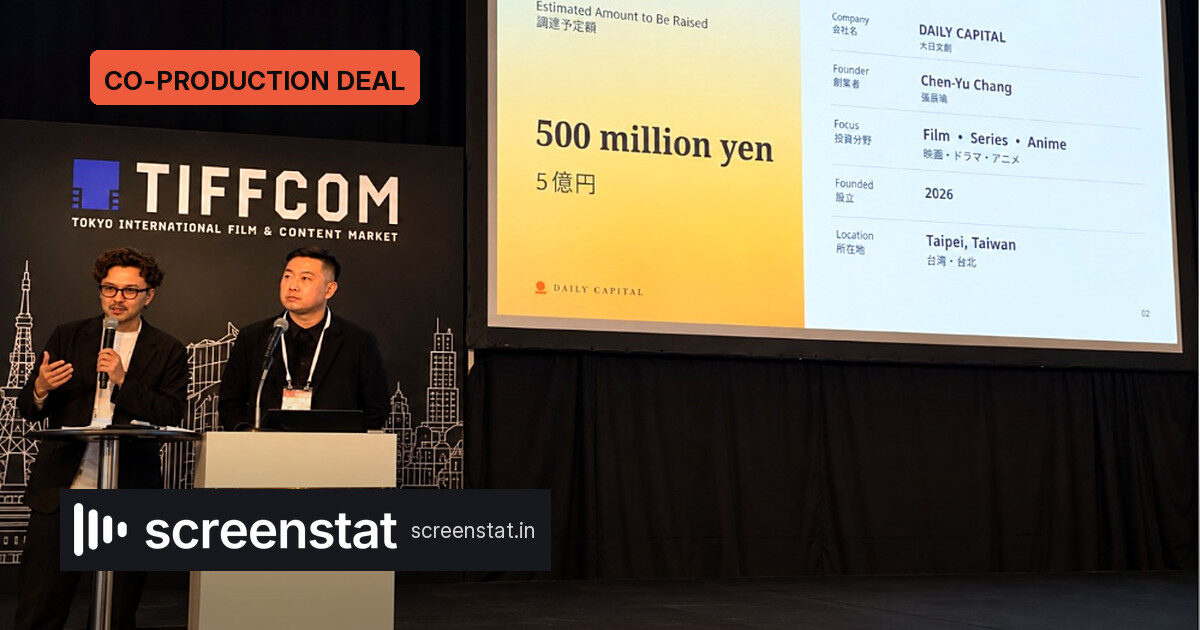
Daily Capital, a new Taiwan-Japan co-production fund, opened TIFFCOM with a specific plan: raise NT$100 million (about $3.1 million), back at least five projects in its first two years, and put Japanese IP and production know-how to work with Taiwanese financing.
Founder Chang Chen-yu said fundraising has reached 70% of the target, and the fund expects to begin operations by year-end.
What the fund will actually do
Daily Capital plans to enter projects during development or pre-production, not as a last-resort financier. Chang said the fund will contribute to script discussions, help assemble core creative teams and aim to recover primary capital within three years.
The model pairs Japan’s established IP libraries and production infrastructure with Taiwan’s co-production experience and incentives, then uses distribution networks to push projects beyond Japanese- and Mandarin-speaking markets.
In Japan, the fund has named K2 Pictures and Remow as co-development partners. K2, founded by producer Kii Muneyuki, gives Daily Capital a line to filmmakers such as Iwai Shunji, Miike Takashi, Nishikawa Miwa and Kore-eda Hirokazu. Remow’s backers include Shueisha, Toei, Amuse, Shochiku, TBS Holdings and Fuji Media Holdings, which brings IP access and distribution reach.
First bet: a 1930s cross-border romance
The fund’s first announced investment is “Love Ends in Bloom,” a 10-episode historical romance and business drama set in 1930s Chiayi and Alishan. The story follows a Japanese geisha who creates a cross-border marriage scheme to save her mother and then falls into a forbidden romance with a Taiwanese timber magnate, set against Taiwan’s cypress industry during the Japanese colonial period.
Written by Juliana Hsu (“Gold Leaf”) and directed by Sun Jie-heng (“Three Tears in Borneo”), the project is slated to begin filming in February 2027 with a mid-2028 release target.
Why this matters for screen businesses
For producers and financiers, the fund’s early-stage entry is a signal: development capital is moving into regional co-productions, not just finished content. At $3.1 million, it is a small vehicle, but the structure tells Asia’s content market where money can travel when broadcasters and streamers want local-language stories with cross-border appeal.
- The fund wants projects that can reach Japanese broadcasters, regional platforms and global streamers.
- It plans to invest in film, television and animation, so animation-focused pitches are in scope.
- Daily Capital’s success metric is distribution and returns; if that works, a larger second fund could follow.
Producers should pitch before production is locked, arrive with IP or distribution angles, and be ready to talk about capital recovery inside three years.
What comes next
The first operational test is whether Daily Capital can close its remaining 30% and deploy capital quickly. The first production milestone is February 2027, when “Love Ends in Bloom” is expected to start filming. A mid-2028 release would then show whether the fund’s first project can land the Japanese broadcasters, regional platforms and global streamers it is targeting.
Source: Variety