
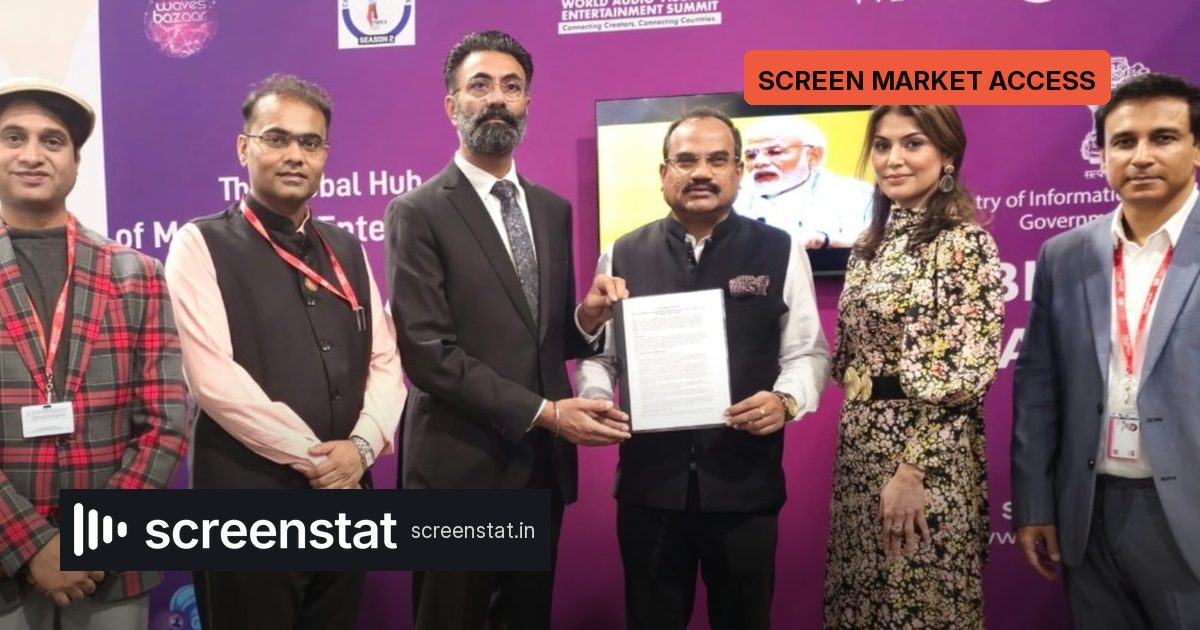
The India-Canada screen corridor now has an official starting point. At the Toronto Film Festival’s industry market, India’s National Film Development Corporation (NFDC) and the South Asian Screen Council of Canada (SASC Canada) signed a Letter of Intent aimed at moving Indian and South Asian projects into Canada’s screen economy.
The LOI was witnessed by the Consul General of India in Toronto and representatives from TIFF. It is not a financing facility or a co-production treaty. It is a market-access arrangement: projects emerging from NFDC will be plugged into SASC Canada’s platforms for content discovery, international programming slates, industry relationships and Canadian market entry.
SASC Canada president Sunny Gill called the initiative “a practical two-way bridge between Canada and India,” connecting talent, projects and industry relationships. NFDC managing director Prakash Magdum said the collaboration gives filmmakers “greater access to festivals, industry partners and audiences” while expanding international reach.
What the pact actually does
The mechanics are useful for producers to understand. The agreement does not guarantee distribution or commissioning. It creates a structured path for NFDC-backed projects to be seen by Canadian programmers, festival programmers and South Asian screen industry leaders.
- NFDC projects get a route into SASC Canada’s discovery and programming networks.
- Indian filmmakers gain access to Canadian market entry for content, talent and partnerships.
- Canadian and South Asian storytellers in Canada get a two-way connection to India’s industry.
- The focus is on moving beyond festival selection into deeper market engagement.
SASC Canada bills itself as Canada’s largest South Asian screen ecosystem, with initiatives including IFFSA Toronto and the South Asian Screen Office of Canada. That reach matters because Canada’s South Asian audience and industry infrastructure have become increasingly important to both broadcasters and streaming platforms.
Why this matters for ScreenStat readers
For Indian producers, Canada is often treated as a secondary market after the US, the UK or the Gulf. This LOI signals that the Canadian South Asian screen sector wants to formalise its role as a buyer, co-producer and programming partner rather than relying on one-off festival selections.
For Canadian platforms and programmers, the pact lowers the search cost for Indian content. NFDC can act as a quality filter and pipeline, which is useful when buyers are evaluating a high volume of South Asian projects without a clear sense of where they fit in the slate.
The risk is the usual one with letters of intent: activity without conversion. The relevant yardstick will not be how many projects are introduced, but whether any move into development deals, commissions, distribution agreements or co-production arrangements in the next 12 to 24 months.
The framework to watch is festival-to-market conversion: a project may get selected at TIFF, but market access only becomes real when it generates a meeting that turns into a term sheet. This pact is designed to improve that conversion step, not to replace it.
Source: Variety